Outsourcing has long stopped being something rare or suspicious. Today, it is a normal part of the modern business model: companies outsource IT, customer support, marketing, design, development, analytics, e-commerce, logistics, HR, accounting, operational processes, and dozens of other functions.
And it makes sense. It is not always beneficial for a business to keep everything in-house. Sometimes an external team is faster, more experienced, more flexible, and more cost-effective than a lengthy hiring and training process. According to the Deloitte Global Outsourcing Survey, 80% of executives plan to maintain or increase their investments in third-party outsourcing, while 50% already use outsourcing for front-office functions, including sales, marketing, and R&D. The BPO market itself also continues to grow: Grand View Research valued it at $328.4 billion in 2025 and forecasts growth to $695.8 billion by 2033.
So the question is not whether businesses need outsourcing.
They do.
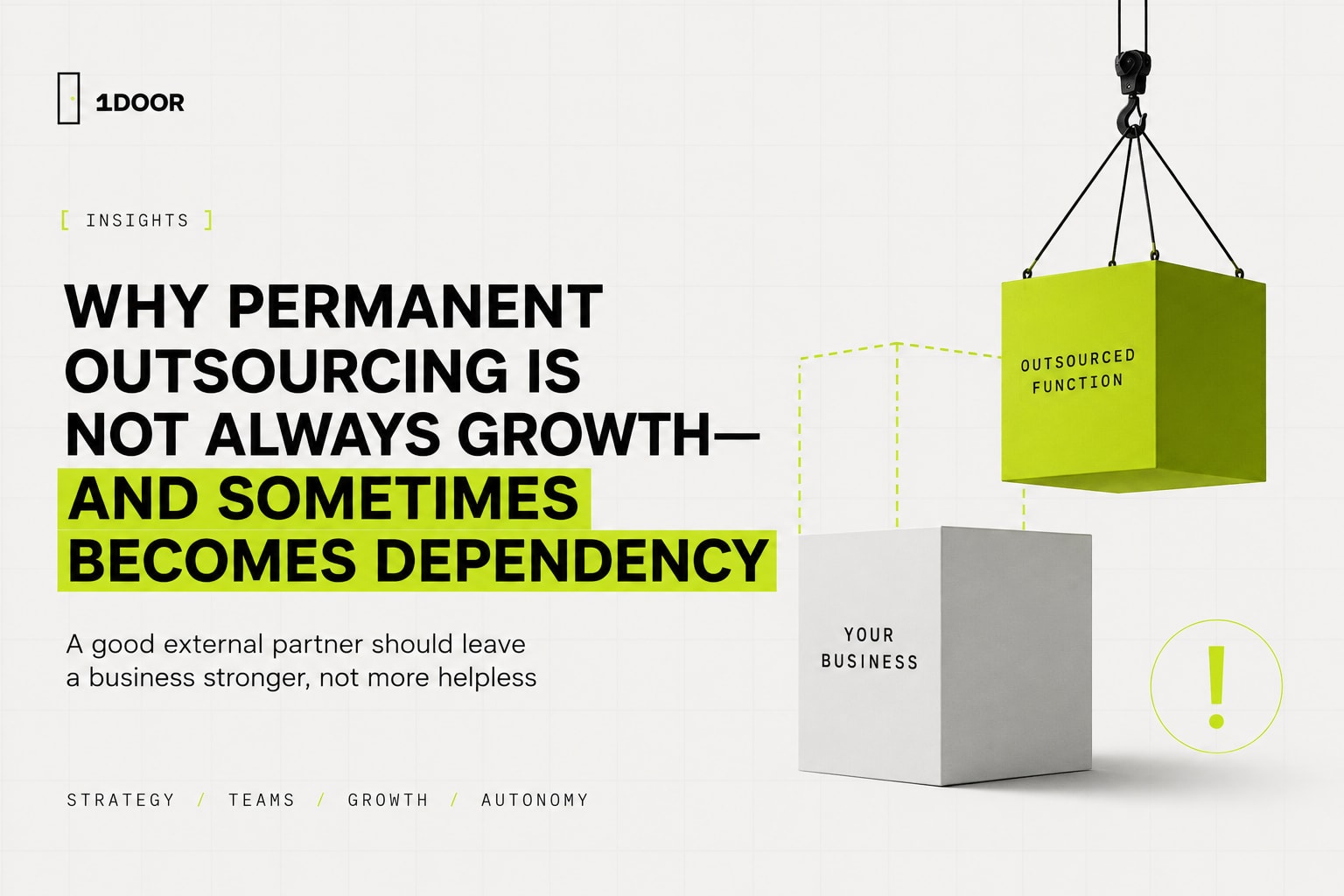
The real question is: does outsourcing make the business stronger, or does it gradually make it dependent?
WHAT IS THE PROBLEM?
Bad outsourcing very often turns a task into a black box.
A client comes with a problem, pays for a solution, waits, receives the result, accepts the project — but almost nothing inside the company becomes stronger. The team does not understand how the decisions were made, does not know which metrics to track, cannot explain why the system works the way it does, and does not understand how to develop it, adapt it, or apply it to new challenges.
From the outside, the job looks done. Inside, nothing has really changed.
I have seen this happen with a design system. A business commissioned its development from an external agency. The agency did the work, delivered the result, and the project was accepted. But afterwards, the internal design team needed months and quarters to rework that design system around the actual needs of the business.
Not because the system itself was bad.
But because it had been delivered as a finished artifact rather than becoming a living tool within the team.
And this is a very common trap.
Formally, the task is complete. In practice, the business still has no idea how to live with the result.
How should decisions be made within the new framework? How should the system evolve?
Which elements can be changed? Which cannot?
How should effectiveness be measured? How should new people be trained?
How do you use the result not only under the ideal conditions of a presentation, but in everyday work?
In this situation, outsourcing does not develop the business. It creates an external layer without which the company eventually starts to feel insecure.
WHEN OUTSOURCING IS USEFUL
Outsourcing can be an excellent solution when a business needs speed, rare expertise, temporary reinforcement, access to experience it does not have internally, or support for a project that should not become a permanent internal function.
For example, a company may need to quickly launch a new business direction, conduct an audit, handle a complex performance sprint, build a brand strategy, or get an external perspective on processes that have become too familiar internally.
For startups and small businesses, outsourcing often helps avoid hiring an expensive team too early. For mid-sized businesses, it can close a senior expertise gap. For corporations, it is useful when they need to quickly bring in specialized expertise that would take too long and cost too much to build internally.
But every model comes with risks.
For a small business, the risk is that all critical expertise remains outside the company: the contractor leaves, and the entire function stops.
For a mid-sized business, the risk is that the team becomes accustomed to buying solutions but never learns how to manage them.
For corporations, the risk is that the external process becomes yet another layer of bureaucracy that appears to help but actually slows down change.
And in every case, the main question is the same: what remains inside the business after the external team finishes its work?
SIGNS OF TOXIC OUTSOURCING
❌ The task disappears into a black box
The client’s team does not understand what is happening inside the process: the contractor delivers a finished result but does not explain the logic behind the decisions. The risk is that the business can neither evaluate the quality, replicate the success, nor properly develop the system further.
❌ All expertise remains outside the company
If only the contractor knows how everything works, the business becomes dependent. Every change, new task, or crisis means going back to the external team.
❌ The process is not documented
There are no clear rules, roles, templates, decision-making logic, KPIs, or areas of responsibility. As a result, the project may technically be complete, but the team cannot integrate it into its everyday work.
❌ Decisions are made on the basis of “the contractor said so”
This is convenient in the short term, but dangerous in the long term. The business stops developing its own thinking and its ability to ask the right questions.
❌ If the contractor leaves, everything falls apart
This is the ultimate test: if the function cannot survive after the external team exits, then the business has not bought a system. It has bought temporary support.
❌ The internal team has learned nothing
People received the result, but not a new level of understanding. When the next project comes along, the company finds itself back at the same point of dependency.
SIGNS OF A HEALTHY MODEL
🌿 The external team strengthens the business’s thinking instead of replacing it
The contractor does not simply execute the work. It helps the client better understand the task, the process, and the decisions being made. This builds managerial and professional maturity inside the company.
🌿 Knowledge transfer is built in
The client’s team understands what was done, why it was done that way, and how to work with it going forward. This can take the form of training, workshops, documentation, guides, reviews, collaborative work, or regular sessions.
🌿 Roles and responsibilities are transparent
Everyone understands who makes decisions, who is responsible for the result, who maintains the system after the project ends, and where the external team’s responsibility stops.
🌿 The tools remain inside the business
Not just a presentation or a report, but actual working materials: processes, templates, frameworks, a content system, dashboards, a roadmap, rules, a playbook, or a trained team.
🌿 The business can continue developing the result
After the project, the company does not have to become completely self-sufficient in everything. But it should be stronger than it was before the work began.
🌿 The business can return to the partner without becoming dependent on them
A healthy model does not mean the relationship with the external team has to end. Quite the opposite: there can be a subscription model, ongoing support, regular reviews, strategic sessions, community access, or targeted expert reinforcement.
The difference is that the business returns intentionally, not because everything collapses without the contractor.
WHY THIS MATTERS ESPECIALLY NOW
Outsourcing is not getting smaller. It is getting bigger.
And it is becoming more complex.
In its recent materials, Deloitte no longer talks simply about outsourcing, but about multidimensional sourcing: companies combine external providers, internal centers of expertise, AI, automation, outcome-based models, and an extended workforce. In another report, Deloitte notes that 67% of organizations use outcome-based outsourcing models, where the focus shifts toward measurable results and innovation.
This means the old model of “outsource the task and forget about it” is gradually becoming obsolete.
Businesses do not simply need contractors anymore. They need a manageable system of internal and external expertise. One where an external team helps solve the problem without taking away the company’s ability to think, manage, and develop.
Otherwise, outsourcing becomes a very expensive habit.
First, a business outsources one task. Then a second. Then a third. Eventually, it turns out that no one inside the company understands how the key processes work, why certain decisions are made, which metrics matter, or what to do if the contractor changes its team, raises its fees, or simply leaves.
That is not growth.
It is a subscription to someone else’s hands, with a gradual loss of independence.
HOW 1DOOR WORKS
1DOOR can be an external team. It can be a project team. It can provide expert reinforcement. It can be a subscription-based partner. It can help launch a new direction, manage a process, solve a complex task, or bring in the right specialists.
But we do not want to turn a business into a contractor’s hostage.
Because 1DOOR is not simply a service agency. It is a community of experts who live and breathe marketing, business, e-commerce, analytics, strategy, brands, processes, and team development.
We bring expertise not only in the form of finished solutions, but also as a way of thinking and working. Through tools, frameworks, collaborative work, training, masterclasses, webinars, camps, articles, reviews, news, practical case discussions, and the constant exchange of experience within the community.
Your specialists can also become part of this environment. They can learn, look at challenges from a broader perspective, access fresh expertise, discuss solutions, develop their professional perspective, and bring all of that knowledge back into the company.
And that is the fundamental difference.
We can run a project for as long as necessary. But if the business becomes weaker without us during that process, then the model has been built incorrectly.
Our goal is different: after the project, the company should be left with a system, people, knowledge, autonomy, and the ability to return to us not out of dependency, but for the next level of expertise.
PRACTICAL ADVICE
Before outsourcing a task, ask yourself five questions:
1. What will remain inside the company after the project is completed?
2. Who on the internal team will understand the logic behind the decisions?
3. What tools, processes, or knowledge will be transferred?
4. Will we be able to maintain the result without daily dependence on the contractor?
5. Are we buying temporary execution, or are we building capability inside the business?
If the answers are unclear, the risk of dependency is high.
In that case, it is worth agreeing in advance not only on the final result, but also on the knowledge-transfer format, the role of the internal team, documentation, training, support, and the rules for further developing the system.
FURTHER READING
To understand how widespread outsourcing has become and why it is now a normal part of the operating model, take a look at the Deloitte Global Outsourcing Survey. It clearly shows that companies are not moving away from external providers. Instead, they are learning how to manage increasingly complex ecosystems of sourcing models.
To understand the scale of the market, the Grand View Research report on BPO is useful. It shows that outsourcing continues to grow as a major global market, particularly against the backdrop of cloud technologies, AI, automation, and digital transformation.
As an example of the risks associated with poor management of external services, take a look at the recent Capita case in the UK. The company suffered a significant hit to profits due to problems with pension scheme administration, once again raising questions around service quality, remediation costs, and the dependence of public-sector processes on external providers.
FINAL THOUGHT
Outsourcing is not bad.
It becomes bad when it turns a business into a spectator of its own processes.
It becomes bad when a task disappears into a black box.
It becomes bad when all expertise remains outside the company.
It becomes bad when the team gets a result but gains no understanding.
It becomes bad when, a year later, the company still does not know how to manage the system it has already paid for.
Healthy external expertise works differently: it solves the task while making the business stronger at the same time.
This is the fourth principle of 1DOOR.
We do not make businesses dependent on outsourcing. We build systems, teams, and internal expertise that help companies grow autonomously.
A good project should leave the business stronger than it was before the external team came in.
Comments
No comments yet. Be the first.