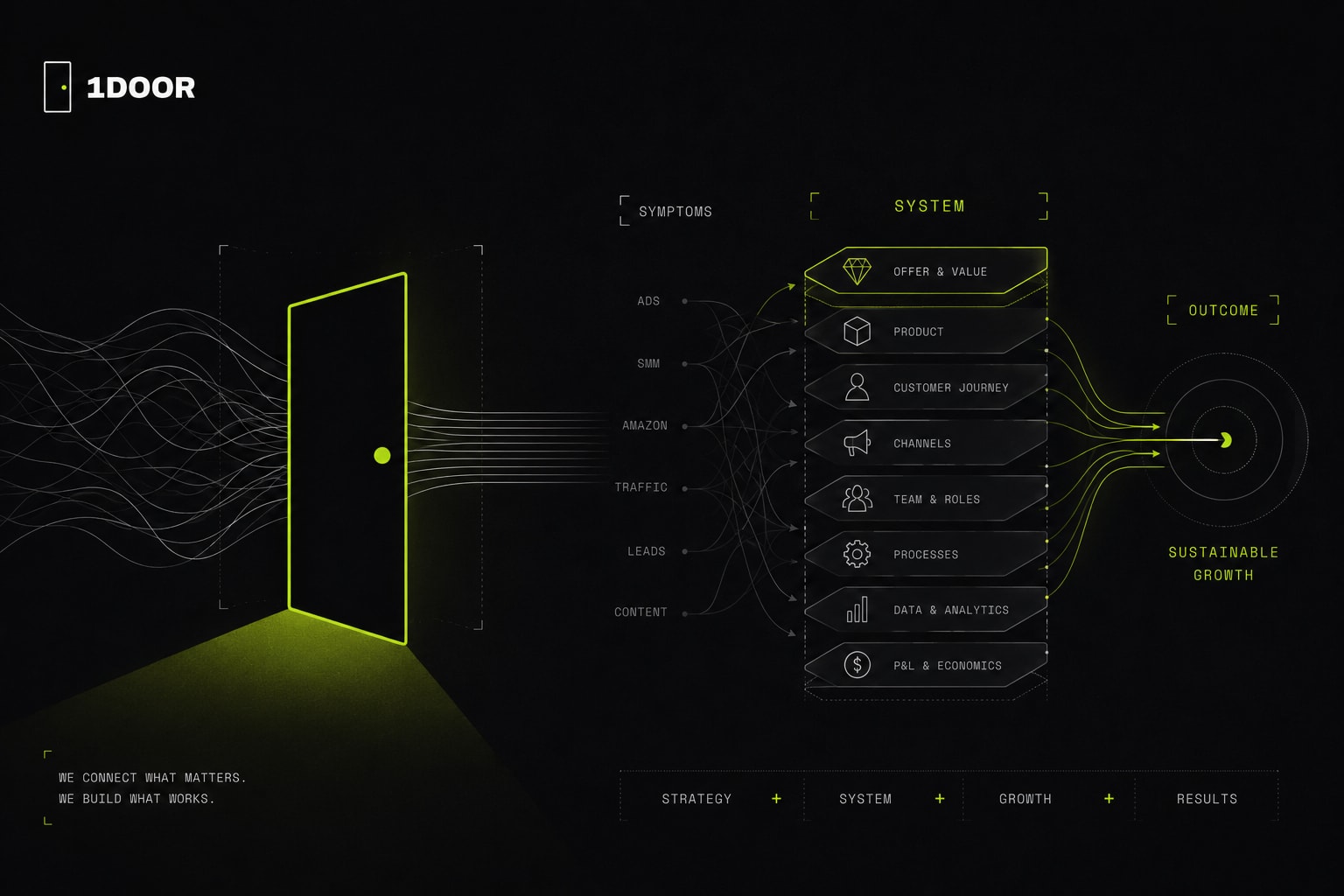
WHY MARKETING DOES NOT EXIST SEPARATELY FROM THE BUSINESS, EVEN WHEN IT SOMETIMES TRIES VERY HARD
Very often, a company has the feeling that something is not working as it should: sales are growing more slowly than expected; advertising has stopped delivering a clear result; social media is being managed, but it is unclear what it actually brings to the business; a new product has been launched, but the market has not picked it up; the team is taking a lot of action, yet there is still no sense of moving forward.
At moments like these, it is natural to look for a quick and specific lever: increase advertising, redo the creatives, hire a specialist, find a new agency, add more budget, and so on.
And sometimes this really can help. There are situations where the problem genuinely lies within a specific channel: poorly configured advertising campaigns, unsuccessful creatives, inconsistent content, the absence of a clear communication strategy, or a lack of expertise within the team.
But quite often, the channel is simply the most visible place where a deeper problem shows up.
Advertising may fail not because the targeting is poorly configured, but because people are being offered a weak or unclear proposition. SMM may fail to convert not because the content is bad, but because after seeing an interesting post, the customer lands on an inconvenient website, a weak product page, or enters a purchasing process that no one has properly thought through. Amazon may fail to grow not because the listings are not visually attractive enough, but because the business has no system for managing assortment, stock, reviews, content, pricing, promotion, and operational support.
That is the difficulty: the business thinks it is looking at a marketing problem, when in reality it is looking at the place where a problem in the entire system has surfaced.
Marketing very often becomes a display window for internal misalignment.
If the product is difficult to explain, it will show in advertising.
If the offer is weak, it will show in performance marketing.
If the customer journey is falling apart, it will show in SMM.
If the team has not agreed on roles, it will show in the speed of execution.
If there is no internal process, it will show in every external channel.
So sometimes the question is not how to do more marketing. The question is what exactly is preventing marketing from working.
And this is where a conventional agency perspective is often not enough.
Not because agencies are bad. A good agency can deliver its part of the work extremely well: conduct an audit of advertising campaigns, review creatives, suggest new formats, improve the account structure, update the content plan, or prepare communication recommendations.
But if the team looks only at the channel, it may identify the symptom without having enough expertise to help the business address the cause.
For example, an agency may honestly say: your offer is weak.
That is already valuable. But then the business needs not only a diagnosis, but also a clear answer to what exactly should be done with that offer. Should the value of the product be strengthened? Should the promotional mechanics be changed? Should the landing page be rebuilt? Should the audiences be segmented? Should more proof be added? Should the business work with pricing, bundles, category positioning, or commercial logic?
The same applies to SMM. It is possible to say that social media does not sell because there is not enough sales-focused content. But if, after seeing a post, the customer moves into an e-commerce environment with no clear logic of choice, weak product pages, an inconvenient path to purchase, or no trust-building elements, another ten Reels will not solve the problem. The whole customer journey needs to be examined, not just the feed.
The same applies to Amazon. It is possible to decide that the problem lies in the visual quality of the listings. But if the team has no process for managing assortment, reviews, stock, content, advertising, KPIs, and operational responsibility, new and visually improved listings will quickly hit the same ceiling.
That is why a business does not always need another contractor who performs one function well. Sometimes it needs a team that understands how that function is connected to the product, price, channel, team, processes, P&L, e-commerce, CRM, logistics, and customer experience.
WHAT THE 1DOOR APPROACH CHANGES
1DOOR is not built like a traditional agency with a group of narrow specialists, each responsible only for their own function.
It is a community of strong professionals with very different backgrounds: people from corporations, small and medium-sized businesses, entrepreneurs, contractors, freelancers, and experts who have worked within complex structures and at the intersection of different business models.
B2C and B2B. Retail and e-commerce. Marketing and commercial functions. CRM and sales. Category management and procurement. P&L and pricing. Logistics and operational processes. Work with government regulators. Team management. Product launches. Process development. Brand growth.
The founders and experts of 1DOOR have many years of experience working with global companies and brands, including Mars, Ferrero, De’Longhi, Apple, Bang & Olufsen, LVMH, and L’Oréal Luxe.
This is an important difference.
When a team has only an agency perspective, it often sees the channel. When a team has first-hand business experience, it sees the system.
Even more importantly, different areas of expertise do not exist separately from one another within 1DOOR.
We have built a model in which specialists strengthen one another. An e-commerce expert can help a marketer see a problem in the product listing, stock, or channel logic. A commercial expert can highlight a weakness in the offer. A brand strategist can see that the problem is not advertising, but unclear positioning. An analyst can show exactly where the customer is being lost. A CRM specialist can explain why the first purchase does not turn into a repeat purchase.
This is how we move beyond a simple list of observations.
This is how a practical system of recommendations is created.
EXAMPLE 1. ADVERTISING IS NOT WORKING
On the surface, it looks as though the problem lies in the advertising campaign.
Few clicks. Expensive leads. Weak conversion. Low ROAS. Creatives burn out quickly. The audience does not respond.
The most obvious solution is to change the targeting, create new creatives, test different formats, increase the budget, or replace the performance specialist.
Sometimes this is genuinely necessary.
But often, a proper analysis reveals that the advertising is bringing people to an offer that does not stand up to market comparison. The product value is unclear. The price feels too high. The advantage is expressed too broadly. The landing page does not address key concerns. The customer does not understand why they should choose this particular brand.
In this situation, the task is not only to “restart the advertising.”
The possible solutions may be broader:
- rebuild the offer and communicate the value more clearly;
- change the structure of the landing page;
- separate communication by audience segment;
- strengthen proof points through reviews, guarantees, cases, comparisons, and demonstrations;
- revise the promotional mechanics or commercial proposition;
- connect advertising with CRM, retargeting, and subsequent touchpoints.
This is where the value of 1DOOR lies: the team does not stop at the statement, “Your offer is weak.” We can help identify why it is weak, how it can be strengthened, and which departments need to be involved so that the solution does not remain just another recommendation in a presentation.
EXAMPLE 2. SMM DOES NOT SELL
This is a very common situation: a business looks at its social media and says that it is not generating sales.
The first instinct is understandable. We need more content. Better creatives. More frequent posting. More Reels. A videographer. More budget. An agency that will “create sales-driven SMM.”
But SMM is not always supposed to sell directly. And even when it contributes to sales, it does not do so alone.
A person may see a post, become interested, visit the profile, open the website, review the product, leave, return through search, ask a friend, see an advertisement, receive an email, visit a store, and only then make a purchase.
If, after seeing a post, the customer lands on a broken website, a weak e-commerce environment, an unclear product page, an inconvenient enquiry form, or reaches a manager who responds two days later, the problem is not that the SMM is not sales-focused enough.
The problem is that the customer journey falls apart after the initial interest.
The possible solutions here are also not limited to content:
- define the role of SMM within the customer journey;
- review the path from the post to the purchase or enquiry;
- synchronise content with the website, e-commerce, CRM, and sales;
- rebuild messages for different stages: awareness, trust, choice, purchase, and return;
- set up UTMs, events, analytics, and a clear system for evaluating impact;
- remove unnecessary formats and keep those that genuinely support the business objective.
In this case, good SMM becomes not a publishing schedule, but part of the overall growth system.
EXAMPLE 3. AMAZON DID NOT TAKE OFF
Another common example is a business entering Amazon or another marketplace and expecting that simply being present in the channel will start generating sales.
Then it turns out that there is traffic, but few sales. Or sales are unstable. Or the listings do not rank. Or reviews do not grow. Or advertising consumes the budget. Or the team does not understand what to do next.
On the surface, it looks as though the listings are unattractive or the advertising is poorly configured.
But in reality, the problem may be deeper. There is no process for managing assortment. There is no content logic. Roles within the team are not defined. There is no regular work with reviews. Operational support is insufficient. It is unclear who is responsible for pricing, stock, promotions, analytics, listings, and optimisation.
Possible solutions include:
- conducting an audit of the business’s readiness for the channel;
- rebuilding the listings not only visually, but also in terms of content;
- defining a process for managing assortment, content, reviews, and stock;
- setting up regular KPI monitoring;
- distributing roles between marketing, e-commerce, commercial, and operations teams;
- training the internal team so that the channel does not depend entirely on an external contractor.
In other words, Amazon does not fail to “take off” because someone forgot to add a beautiful image. It fails because the channel requires a system. And that system needs to be built.
WHAT APPROACHES TO SOLVING THE PROBLEM ARE AVAILABLE
When a business faces a marketing problem, there are usually several options.
The first option is to fix the channel locally. This is fast and can sometimes be effective, for example, when the problem genuinely lies in campaign settings, weak visuals, or the absence of a clear content process. But this approach is ineffective when the cause lies deeper.
The second option is to commission an audit. This helps identify the problem. But an audit does not solve the task on its own if there is no implementation plan, no team, and no clear responsibility afterwards.
The third option is to hire a specialist. This works well if the business understands exactly whom it is hiring, why, which tasks that person will solve, and what kind of system they will enter. But if the system has not been built, even a strong specialist can quickly burn out or become the person trying to compensate for structural problems that belong to other functions.
The fourth option is to build a cross-functional solution. To look at the task through the product, channel, customer, team, processes, and economics. This is more difficult at the beginning, but it usually produces a more sustainable result because the business fixes not only the symptom, but the entire connection that influences growth.
The fourth option is the one closest to the 1DOOR philosophy.
WHICH 1DOOR SERVICES CAN BE RECOMMENDED IN THIS SITUATION
If a business feels that marketing is “doing something,” but the result is not coming together, it is better to begin with diagnosis and cross-functional analysis.
BUSINESS REQUEST TRANSLATION
We help translate a broad request such as “we need advertising,” “SMM does not sell,” “Amazon is not working,” or “we need more sales” into a specific business task. We determine where the problem actually lies: in the channel, product, offer, process, team, customer journey, or the connection between them.
CUSTOMER JOURNEY AUDIT
We examine the entire customer journey: from the first interaction to purchase, repeat engagement, and loyalty. We identify the points where attention, trust, conversion, revenue, or customer experience are being lost.
PERFORMANCE AND CHANNEL AUDIT
We analyse advertising campaigns, channels, KPIs, creatives, landing pages, and the relationship between marketing activity and business results. Importantly, the audit does not end inside the advertising platform. We examine what happens around it.
OFFER AND COMMUNICATION REVIEW
We assess how clearly the product value, offer, messages, arguments, proof points, and competitive difference are communicated. We provide recommendations not only on wording, but also on what may strengthen the proposition at the business level.
E-COMMERCE AND MARKETPLACE READINESS REVIEW
This is suitable for Amazon, marketplaces, and online sales. We review listings, assortment, content, processes, roles, analytics, promotion, reviews, stock, and the team’s operational readiness.
CROSS-FUNCTIONAL GROWTH SYSTEM DESIGN
We build a system in which product, marketing, sales, CRM, e-commerce, analytics, and the team do not operate as separate fragments, but work towards one objective.
PRACTICAL ADVICE
Before replacing a contractor, increasing the budget, or hiring a new specialist, it is useful to carry out a simple check.
Answer five questions:
Do we clearly understand where the problem actually lies: in the channel, offer, product, customer journey, team, or process?
What happens to the person after their first interaction with an advertisement, post, product listing, or website?
Which departments influence the result we are currently trying to improve?
Does the team have the authority and ability to change the things that genuinely affect the result?
If we increase the budget or the amount of content, what exactly is supposed to change within the system?
If the answers are vague, the problem is most likely broader than one channel. In that case, it needs to be solved not only through marketing, but through the business system.
FURTHER READING
To understand why the customer journey cannot be reduced to a simple linear funnel, it is useful to explore McKinsey’s materials on the consumer decision journey. They explain well that a person goes through different stages of consideration, comparison, choice, and loyalty, which means that a business needs to look beyond a single advertising interaction.
For e-commerce and Amazon, it is useful to study materials from Amazon Ads and Amazon Seller University. They demonstrate clearly that marketplace growth depends not only on advertising, but also on listings, content, reviews, stock, optimisation, and operational discipline.
For SMM and performance marketing, it is also worth reading materials from HubSpot, Hootsuite, and Think with Google on the connection between social media, the customer journey, brand building, and marketing measurement. Their value lies in showing that channels work better when they are integrated into an overall system rather than operating separately from the business.
FINAL CONCLUSION
Marketing does not exist separately from the business.
Advertising will not save a weak offer. SMM will not repair a broken customer journey. Amazon will not become a growth channel if there is no internal process. Performance marketing will not compensate for a product the customer does not understand. Content will not replace a team that does not know what exactly it should say to the market.
This does not mean that advertising, SMM, e-commerce, or performance marketing are unnecessary.
They are necessary.
But they work only when they are integrated into a system.
This is the second principle of 1DOOR.
We understand the business from the inside, not only the marketing from the outside.
We look not only at the channel, but also at what happens before it, after it, and around it: the product, price, offer, team, processes, P&L, categories, logistics, CRM, e-commerce, operations, and the customer journey.
Because a business rarely needs just another person who knows how to press the right buttons. A business needs people who understand how the result is built and who can create a system in which marketing finally stops operating separately from the business.
Comments
No comments yet. Be the first.