When a business faces a new challenge, it often chooses between two familiar options: either train the existing team and try to handle everything internally, or hand the task over to an external contractor and hope that “they’ll figure it out.”
Both options can be right. And both can fail.
Because the real question is not which is better: an in-house team or outsourcing. The question is which model fits the specific task, timeline, level of risk, existing expertise, and the company’s strategic plans.
Modern companies are increasingly moving away from rigid operating structures toward more flexible systems. In its materials on operating models, McKinsey argues that companies need to close the gap between strategy and execution through more flexible, collaborative, and data-driven ways of working. Deloitte, in the context of Build-Operate-Transfer, also describes growing interest in models where an external team does not simply execute the work, but helps build a capability and eventually transfer it into the business.
This is exactly the logic we believe in at 1DOOR: don’t choose a format out of habit. Understand the task first.
WHAT IS THE PROBLEM?
Businesses often make this decision too early.
If there is already an internal team, they simply add another function to its responsibilities. “You’re marketing, so now you’re also doing Amazon.” “You’re SMM, so now you’re also responsible for PR, video, community, and performance.” “You’re e-commerce, so you’ll figure out content, reviews, promotion, and analytics too.”
If the required expertise is missing internally, the task is quickly outsourced. Sometimes this solves the problem. But sometimes the business ends up with a black box: the contractor does something, reports arrive, money gets spent, but the company itself gains neither understanding nor a process nor the ability to develop the function further.
There is a third scenario: buy training. This can be an excellent solution if the team already has a solid foundation, enough time, and a clear area where the new knowledge can be applied. But if the task is urgent, complex, and requires implementation experience, a course alone cannot replace someone who has already been through this process.
That is why the mature choice is usually not between “inside” and “outside.”
It is about finding the right combination.
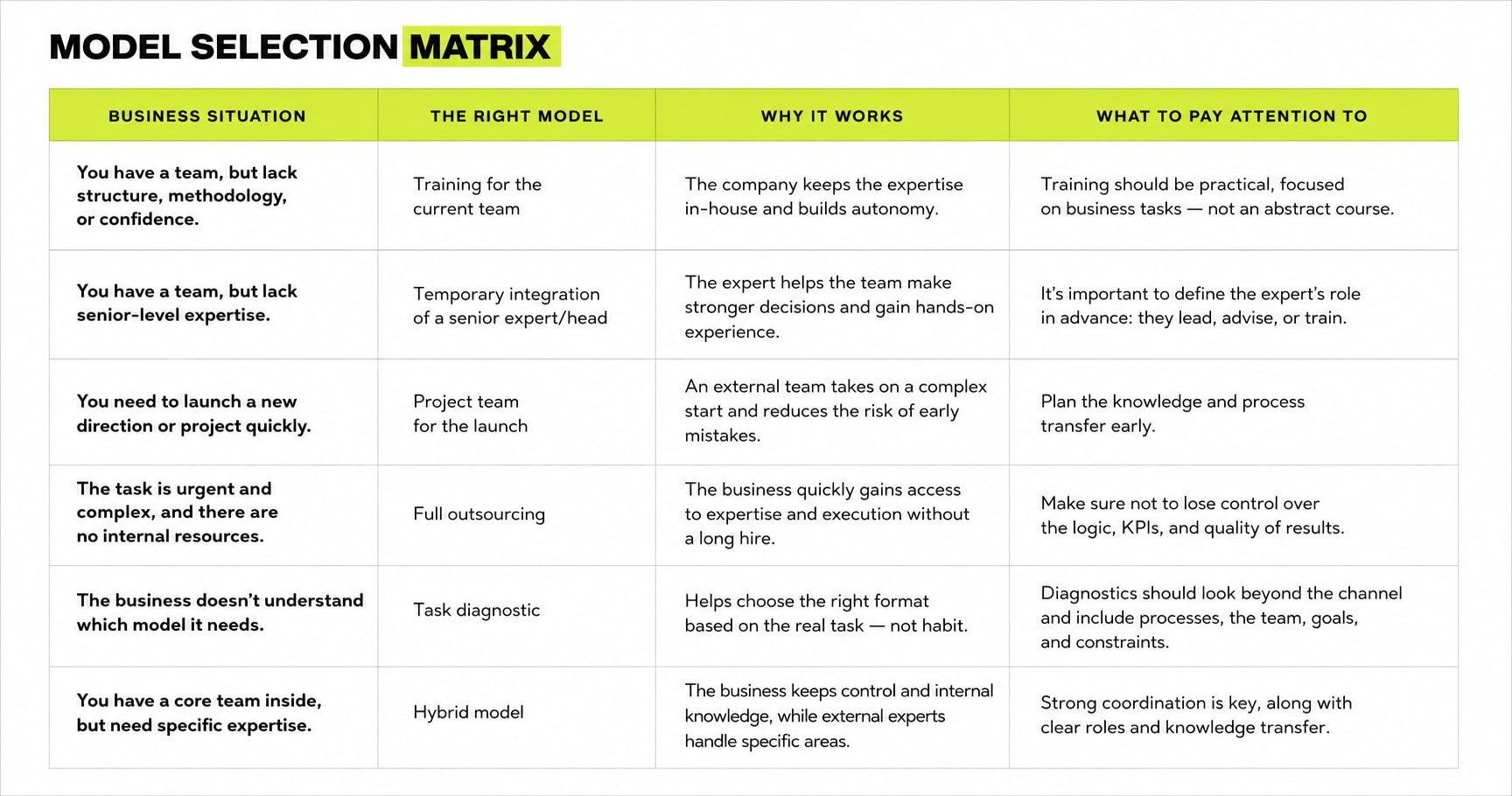
WHAT DOES THIS LOOK LIKE IN PRACTICE?
Imagine a company wants to launch a new e-commerce direction.
It can hire someone in-house. But if no one internally understands how product listings, assortment, content, promotions, reviews, KPIs, and operational support should work together, the new hire may quickly find themselves alone with a system that has not yet been built.
The company can outsource everything to an external team. This will provide speed, but unless knowledge transfer is built into the model from the beginning, the business will remain dependent on the contractor.
Or it can choose a hybrid model: an external project team launches the direction, builds the processes, helps the business navigate the first mistakes, while the internal team learns in parallel and gradually takes ownership of the system.
This is close to the Build-Operate-Transfer model, where an external partner helps build a capability, operates it during the initial stage, and then transfers it to the business.
Another example: a company already has a marketing team, but lacks senior-level expertise.
In this case, it is not always necessary to hire a new full-time Head or replace the agency. Sometimes it is enough to temporarily integrate a strong senior expert who can help restructure processes, conduct reviews, establish strategic logic, train the team, and improve the quality of decision-making.
This is especially relevant now, as the way teams work becomes increasingly flexible. Research into hybrid models in software companies shows that there is no universal configuration that works for everyone: the success of a model depends on the tasks, team dynamics, and organizational strategy.
The same logic applies to business processes.
There is no single perfect model for every task. There is only the model that fits your specific context.
WHY HYBRID OFTEN WORKS BETTER THAN EITHER EXTREME
The strength of a hybrid model is that it does not force a business to choose between control and expertise.
The core team stays inside the company. They understand the product, the brand, the customers, and the internal reality. External specialists provide the expertise that is currently missing: strategy, performance, e-commerce, SMM, CRM, analytics, trade marketing, project management, or another function.
But hybrid models only work with strong coordination.
If the external team takes over everything, the business becomes dependent on it. If the internal team is not involved, knowledge is never transferred. If roles are not clearly defined, chaos follows.
A good hybrid model makes the business stronger.
A bad hybrid model simply creates another layer of management, meetings, and unclear responsibility.
HOW 1DOOR CAN HELP
1DOOR does not sell one fixed way of working.
We can train an existing team, temporarily strengthen it with a senior expert, assemble a project team for a launch, take full ownership of a function externally, or build a hybrid model.
Our team has strong training and management experience, which means we can do more than simply “execute.” We can transfer the approach, tools, logic, and processes to the business.
For us, the goal is not to make a company permanently dependent on outsourcing. The goal is to choose the model that will create the strongest result in a particular situation.
Sometimes the right solution is training. Sometimes it is an external team. Sometimes it is senior-level support. Sometimes it is a hybrid.
And almost every time, the process should start with diagnostics.
PRACTICAL ADVICE
Before choosing between hiring, training, a contractor, or outsourcing, ask yourself five questions:
1. Is this a one-off task, or will it become a permanent function within the business?
2. Does the team have enough time and foundational knowledge to develop this capability?
3. What matters most right now: speed, autonomy, quality, cost efficiency, or risk reduction?
4. What expertise already exists internally, and what is definitely missing?
5. What should remain inside the company after the project: the result, the process, the knowledge, the tools, the team, or all of the above?
If the answers are unclear, don’t start with hiring or outsourcing.
Start by choosing the right model.
FURTHER READING
For the topic of operating models, McKinsey’s recent work on how companies are redesigning the way they operate to close the gap between strategy and execution is worth exploring.
To better understand Build-Operate-Transfer and the transfer of capabilities into a business, Deloitte’s work on the new generation of BOT/BOTT models is useful. It shows how the focus is shifting from pure cost savings toward access to strong expertise and the development of internal capabilities.
For hybrid teams, research into hybrid work in software companies is also worth exploring. It demonstrates clearly that there is no universal model and that success depends on finding the right balance between tasks, people, and organizational strategy.
FINAL THOUGHT
Not everything needs to be done in-house.
Not everything needs to be outsourced.
Not every challenge requires another hire.
And not every project should turn into permanent outsourcing.
Between “let’s buy a course and figure it out” and “let’s hand everything over to an agency,” there are many viable models: training, senior-level support, project teams, full outsourcing, diagnostics, and hybrid structures.
This is the third principle of 1DOOR.
Your team, our team, or a hybrid. We choose what works.
1DOOR helps businesses choose the right model for the task, rather than defaulting to what they have always done.
Because sometimes the right operating model solves more than another specialist, another course, or another contractor.
Comments
No comments yet. Be the first.