I built my first online store in Moscow in 2019. UX wasn't optional there. It was oxygen.
Ship a clumsy checkout and your users were on Mvideo, or Ozon, or any of the other twelve tabs already open. The bar was absurd and everybody just accepted it: the checkout guessed your name, your city, your street, your apartment number before you finished typing. Card, cash on delivery, credit, split into four payments. Miss any of that and you didn't lose 5% of conversion. You lost half.
I moved to Australia carrying that instinct with me, the way you carry an accent. And for a while I filed what I noticed under "different market, different pace" and got on with things.
Then last week I took my son to see The Odyssey at IMAX Melbourne.
Great film. The booking system is where the actual odyssey happened.
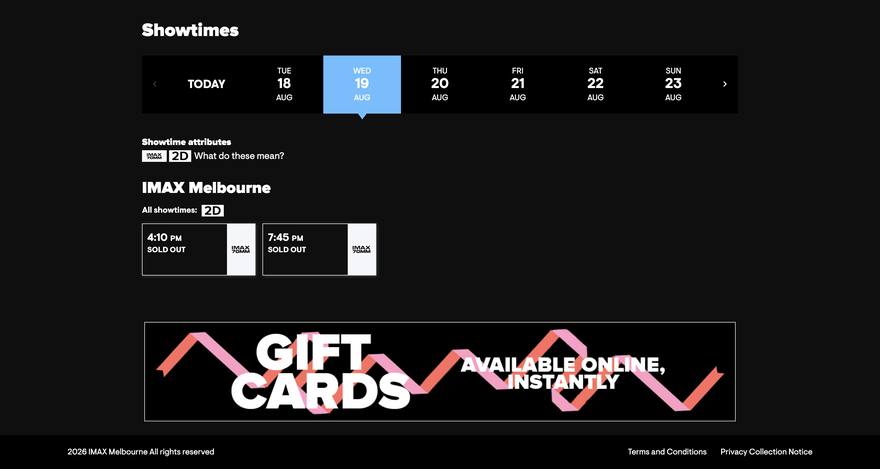
The showtimes page. Sessions listed, some marked sold out, some not. This is where the journey starts.
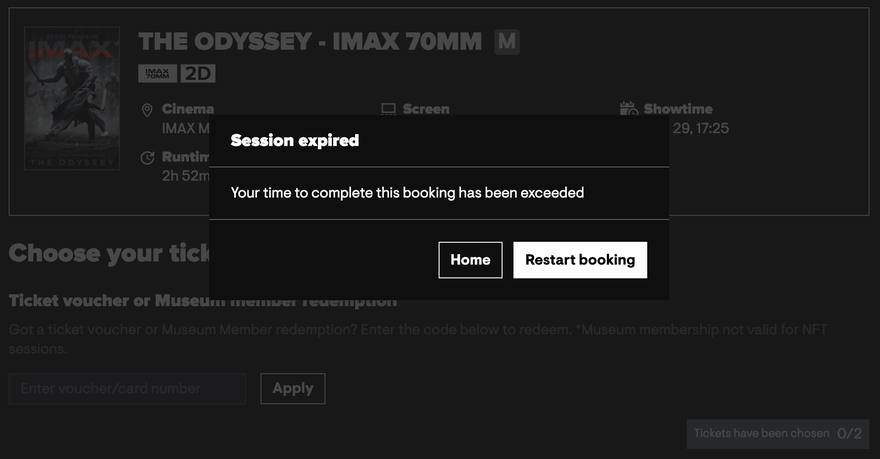
I went looking for seats that the interface promised were there and never found them. Somewhere in that hunt a timer I hadn't been told about ran out, took my selection with it, and dropped me back at the start. I got there on the third attempt, with a few words said out loud that I would not repeat in front of my son.
No countdown, no warning, no saved cart. Just a wall and two buttons.
Standing in the queue afterwards, ticket screenshot on my phone, I caught myself doing something more interesting than being annoyed. I was curious. Because this is not a broke startup shipping v1. This is a cinema that projects laser 4K onto a screen the size of a five storey building. Somebody here cares enormously about experience. Just not this part of it.
So I started paying proper attention. And what I found is not a story about one bad website. It is a story about a market that is sitting on an opportunity it hasn't noticed yet.
The short version
• The economic reason Australian digital experience lagged behind was real, and it is now gone.
• The gap that remains is organisational. It is about priority, not resources.
• That makes it fixable on a timeline of weeks, not years, by people already on the payroll.
• Which means the room for improvement here is not a weakness. It is the largest unclaimed advantage in the market.
The explanation I used to give
Five years back I would have explained Australia's gap like this. You lack the talent density of Shanghai. You lack the cost efficiency of Eastern Europe. You lack the scale of San Francisco. All of that is my opinion rather than gospel, and all of it could sound upsetting but clear.
That explanation is now dead, and it died recently enough that most org charts haven't caught up.
In 2024 and 2025 the economics inverted. ChatGPT Plus costs $20 a month. Figma AI runs about $20 a month. Cursor, UX Pilot, Flowstep and the rest sit somewhere between $19 and $60 a month and do work that used to occupy a senior designer for a quarter. A small team can now buy world class augmentation for $150 to $300 a month in tooling.
Talent you can hire from anywhere. Infrastructure is identical everywhere. The frameworks are free and documented to death.
The cost curve flattened. The speed curve accelerated. The excuse curve should have gone with them.
And yet you keep clicking through Australian sites in 2025 and 2026 and they feel like 2014. Not indie shops. Not startups scraping by. Established companies with revenue, budgets and genuinely sharp people.
Coming from the other side of the planet, I have something to compare against, and I would say this plainly: these same opportunities were taken on other markets close to a decade ago. Not because those markets were smarter. Because competition there made it non optional, earlier.
The gap is measurable, not just felt
This isn't only a vibe. There are numbers underneath it.
Mobile now carries around 62% of Australian web traffic as of January 2026. And Deloitte and Google, studying 37 brand sites across 30 million sessions for "Milliseconds Make Millions", found a 0.1 second improvement in mobile site speed lined up with retail conversion rates 8.4% higher and average order value 9.2% higher. A tenth of a second. That is roughly a blink, and it moves the P&L.
So the place where most of your customers are is also the place where the smallest improvements pay the most. That is where attention belongs.
Meanwhile I kept collecting. IMAX Melbourne alone gave me a full set:
• The session expires after about 15 minutes, the cart resets, and nothing warns you it is coming.
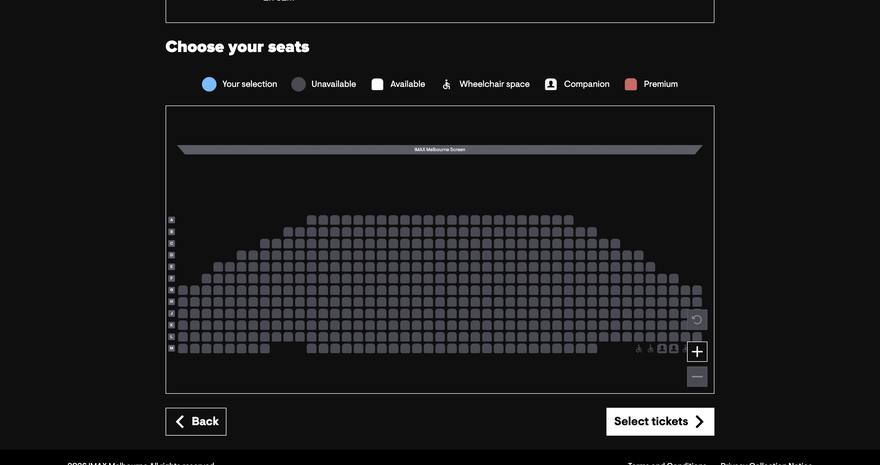
• A showtime advertises available seats, you click through, and there is nothing selectable waiting for you.
• Sold out sessions and sold out days stay in the picker anyway, looking exactly like the ones you can buy.
Every seat rendered, almost none of them selectable. The interface shows you a room and then quietly declines to let you into it.
And this is not one unlucky vendor. I have written about others before:
• [TPG mobile signup](https://1door.cc/blog/tpg-mobile-sign-up-ux-case-study), where an existing customer is forced to create a new account, there is no Back button and no saved progress, and an error arrives as a bare 403 with a support code attached. I spent 77 minutes on the phone across that attempt, 23 of them being told my services could not be merged.
• [Kincrome](https://1door.cc/blog/kincrome-digital-toolbox-audit), holding the smallest share of brand search among its direct competitors, with neglected sale pages, a cart that will not explain itself and a user flow that breaks partway through.
• [L'Oréal Luxe Australia](https://1door.cc/blog/the-luxury-brands-that-lack-luxury-experience), a division running a €15.6B strategy, with "REFIILLS" misspelled on the site itself.
• [Honda Australia](https://1door.cc/blog/honda-australia-ux-mistakes), absent from Google Shopping on a query as central as "hybrid car", a postcode pop-up thrown at you before you have seen anything, and a handoff to the dealership that drops the thread entirely. Honda's market share here has shrunk more than five times since 2007.
• [Dyson](https://1door.cc/blog/we-tried-to-buy-a-dyson-a-copy-got-the-sale), where we set out to buy the real thing and a copy took the sale instead.
Every one of these is a company with capacity, resources, market position and a long established brand. That is what makes it interesting rather than sad.
The ticket that cannot leave the screen
Here is the detail that tipped me from annoyed into genuinely curious.
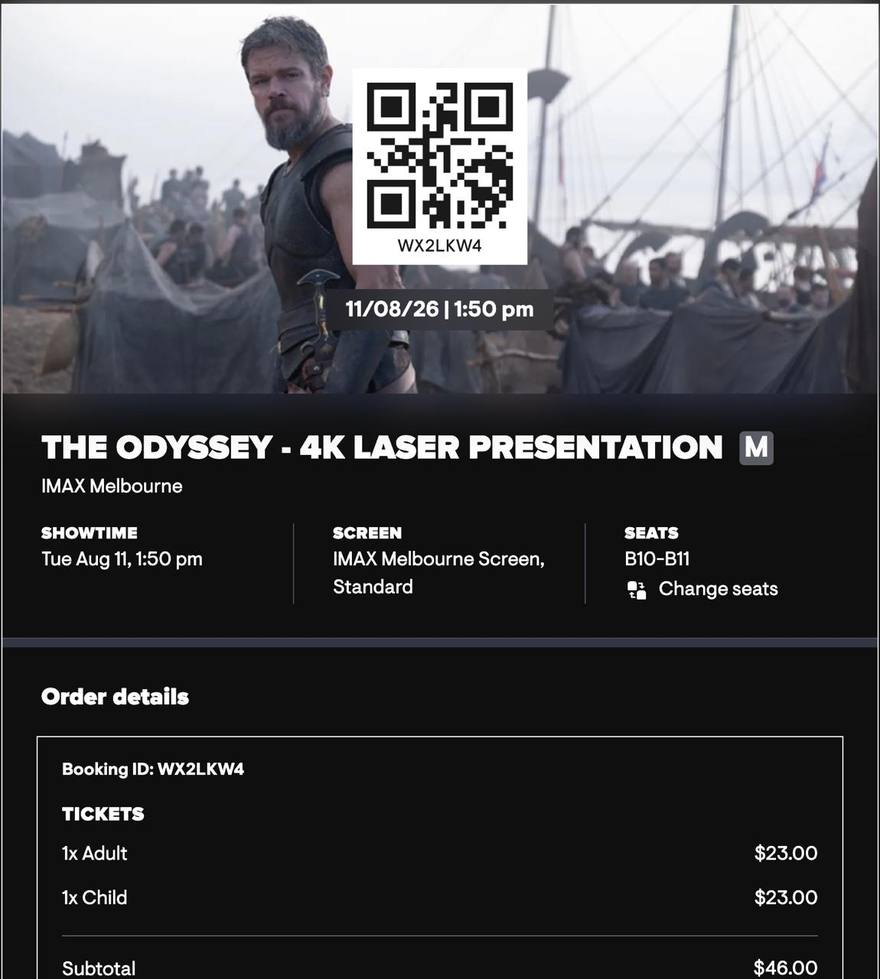
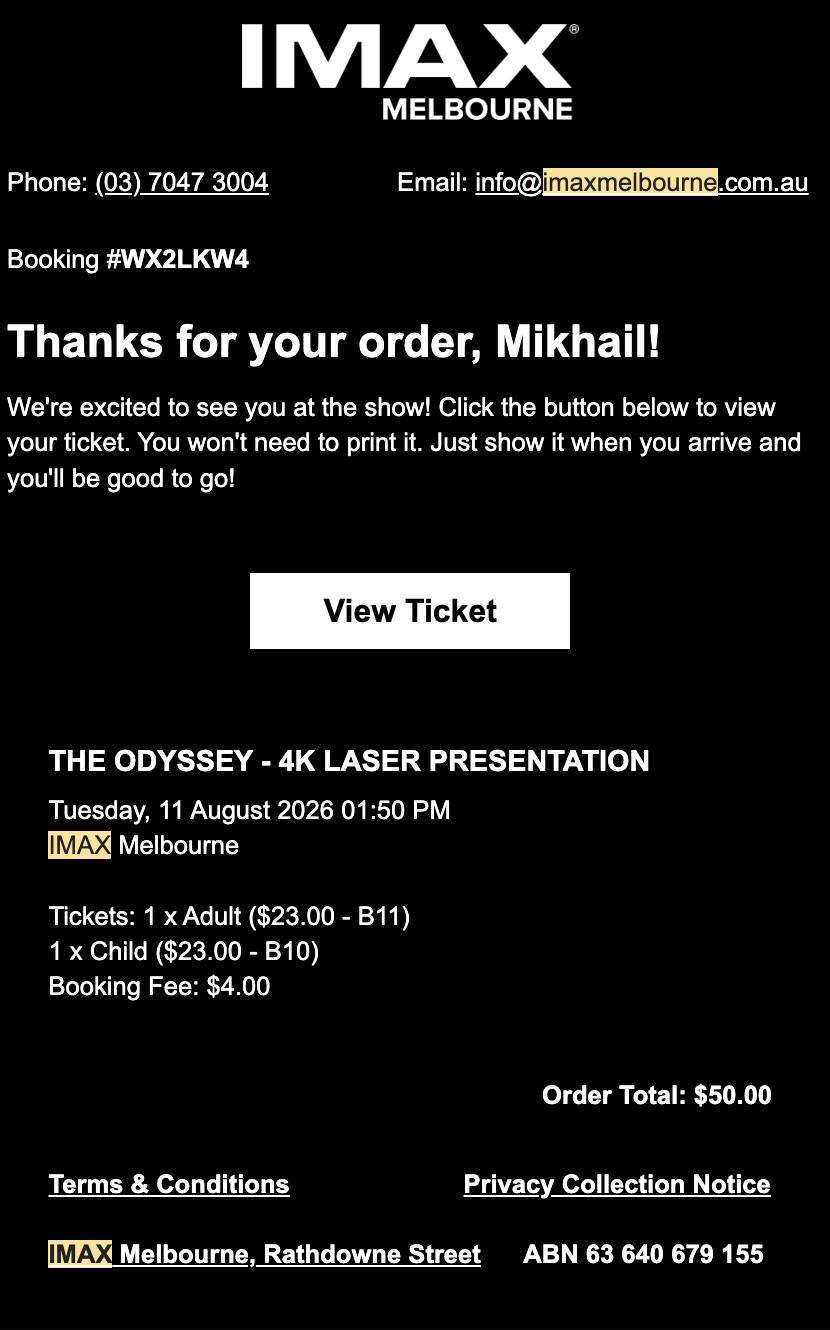
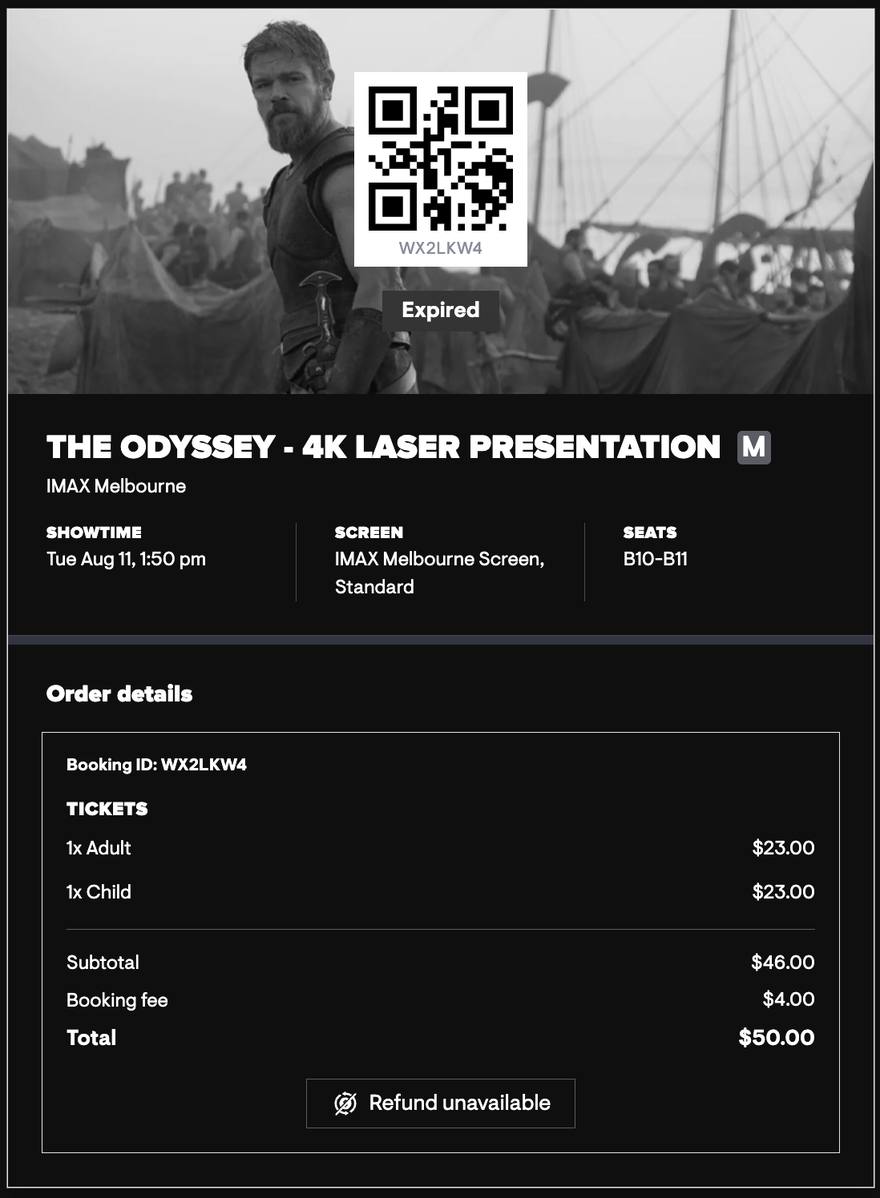
Once I finally paid, I could not add the ticket to my wallet. Not Apple Wallet, not Google Wallet. No PDF. No file of any kind. A screenshot, or nothing.
4K Laser Movie and a QR code you are expected to photograph yourself.
They do email a copy, and credit where it is due, that email arrives fast and is perfectly clear. But it is a link back to the same page, not a pass and not a document.
Which matters more than it sounds, because the cellular signal at the entrance is barely there. When I went to open my mailbox to pull the thing up, the ticket person told me the wi-fi is slow too, and advised me to walk up the stairs a bit to catch a better connection. She said it the way you say something you have said a hundred times before. Which is the part that stayed with me: the workaround has been running long enough to become staff knowledge, and the building is still the same building.
So the design assumes a live connection, at the one spot in the entire journey where the connection is worst, for a document the customer already paid for and cannot hold.
The safety net exists. It just points back to the same screen.
Wallet passes are a solved problem. Airlines, concert venues, football clubs, the coffee shop loyalty card in your pocket right now, all of them handle this. Apple and Google both publish the APIs and most ticketing platforms ship the integration already built.
So the gap here is not budget and not capability. It is that nobody in the building has recently looked at this flow and said out loud: this is from 2014, let's fix it.
Afterwards the ticket greys out and offers you one remaining action: refund unavailable.
How to unlock
Generate Apple Wallet and Google Wallet passes at confirmation, and put a "Download PDF" button next to them. Standard APIs, already present in most ticketing stacks. A senior developer gets both done inside a week.
Call it $5,000 once, with no recurring cost. In return: no lost tickets, no support calls at the door, no customer standing in a queue re-reading their inbox. The maths is not close.
So what is actually blocking this?
I put the question to an Australian founder whose checkout had friction at every step. His answer was honest and, I think, the most useful sentence anyone gave me all month.
Does it? We haven't focused on that yet.
Not defensive. Not dismissive. Just true. It had never been on the list.
That is the whole thing. Plenty of Australian enterprises have solid digital foundations, cloud platforms, analytics, capable teams. What is thinner is the habit of measuring the user's outcome rather than the team's output. So the work never gets prioritised, because nothing in the reporting makes it look urgent.
From what I can see, four things keep it there:
• Shipping beats polishing. Launch now, iterate later. Reasonable at seed stage. Less reasonable twelve years in.
• Internal metrics beat user outcomes. "Did we ship it" is easy to report. "Did they complete it" requires someone to go looking.
• Redesign reads as risk. The current flow works, in the narrow sense that money does eventually arrive. Changing it might break something.
• Nobody owns the conversion rate. An agency builds the flow, ships it and moves on. No skin left in the game afterwards.
In markets where competition is savage, these trade offs get punished within a quarter. Australia has been forgiving enough that they don't. That forgiveness is the thing quietly ending.
Why I think this is good news
Here is what kept me turning it over. The lag used to be explicable. Now it isn't, and that changes what it means.
Ten years ago the maths would explain everything. A world class digital team in Australia started around $350,000 a year and went up from there. The same team in Eastern Europe or the CIS was $80,000 to $100,000. That difference defined the speed and quality of digital evolution over the past decade, and it is why the US, Eastern Europe, the CIS and Asia ended up on the front edge of harnessing digital capability. Meanwhile the honest internal conversation in Australia went: a few points of conversion lift will cost us $350,000 in salary against unclear revenue, and the answer was often no. Fair enough.
Now the same capability costs a few hundred dollars a month in tools, one contract designer and someone senior steering. A single point of conversion pays for the whole thing several times over.
I ran those numbers properly on the TPG funnel. Fixing three things, the returning customer entry, the eSIM choice and human error messages with inline validation, on a conservative 15% relative conversion lift, creates around $27,000 of lifetime margin per month. At 25% it is closer to $45,000. Separately, the support time being burned on broken orders runs to roughly $17,500 a month before you count the physical SIMs posted to people who wanted an eSIM. None of those three fixes is hard. None of them needs a new platform.
The reason for the lag disappeared. Most of the market has not noticed yet. That window is the opportunity.
Which is why I have stopped reading Australian digital as behind and started reading it as unclaimed. Every rough checkout is a competitor who has not looked. The first company in each category to actually look gets to own it, cheaply, using tools their competitors also have and are not using.
That is a nicer game than the one I played in Moscow, where everyone was already sprinting.
What changes in 30 days
• Week 1. Take your single most important flow, checkout or signup or booking, and do it yourself on your own phone, on mobile data, thumb only. Time it. Write down every place you hesitate.
• Weeks 2 and 3. Rebuild one version of it. Figma AI, v0, Cursor, whatever you already pay for. You are not shipping, you are proving it can be better.
• Week 4. Put it in front of a dozen real users. Measure completion time and where they stall. Hotjar will do it, or build the tracking yourself in GTM.
If the prototype is faster and clearer, you have the ROI argument in hand, built for the price of a month's subscriptions. The budget conversation changes after that, and so does the roadmap.
Where 1DOOR comes in
The moment a client asks "why is our mobile conversion lower than desktop" is the moment this work becomes possible, because the question itself creates the mandate.
What we usually find on the other side of that question is not a technical problem. The team is capable. The stack is fine. They have been measuring the wrong things, so the right work never surfaced.
So we map the friction, put a number on what each point of it costs, and hand over a sequence someone can actually run. If any of this sounds like your checkout, come and say hello. It moves faster than people expect.
Can a checkout really be rebuilt in six weeks now?
Yes, if you know what you are building. Clarity is the bottleneck, not execution. Two weeks on research and decisions, two on design and build, two on testing. Tools stopped being the constraint about eighteen months ago.
Isn't some of this just Australian regulation and market size?
Some friction is genuine. Payment gateways, compliance, smaller volumes to amortise cost across. But a session timer with no warning is not regulation. Neither is the absence of a wallet pass. Those are product decisions that nobody revisited.
If it is this obvious, why hasn't everyone done it?
Because obvious and urgent are different things. A flow converting at 2% that should convert at 3% does not feel broken from the inside. It feels normal. The loss is invisible right up until a competitor makes it visible.
What do I do on Monday?
Buy something from your own site on your own phone. Then ask your team why each friction point exists. Most answers will be some version of "it has always been like that". That sentence is the opening.
The last stop
I came to Australia because the market looked interesting. I stayed because the people are sharp and the problems are real. What surprised me is how much room is still sitting on the table, in plain sight, in categories with serious money in them.
It is not a talent problem and it stopped being a budget problem. It is a priority problem, and priority is the one variable a company can change this week without asking anyone's permission.
The interesting race is no longer Australia against Shanghai or San Francisco. It is each Australian company against the version of itself that spends one quarter caring about whether people can finish what they started.
I think a lot of them are about to. My son, for what it is worth, thought the film was worth the three attempts.
Seats B10 and B11. Third attempt. The product was always fine, the road to it was the problem.



Comments
No comments yet. Be the first.