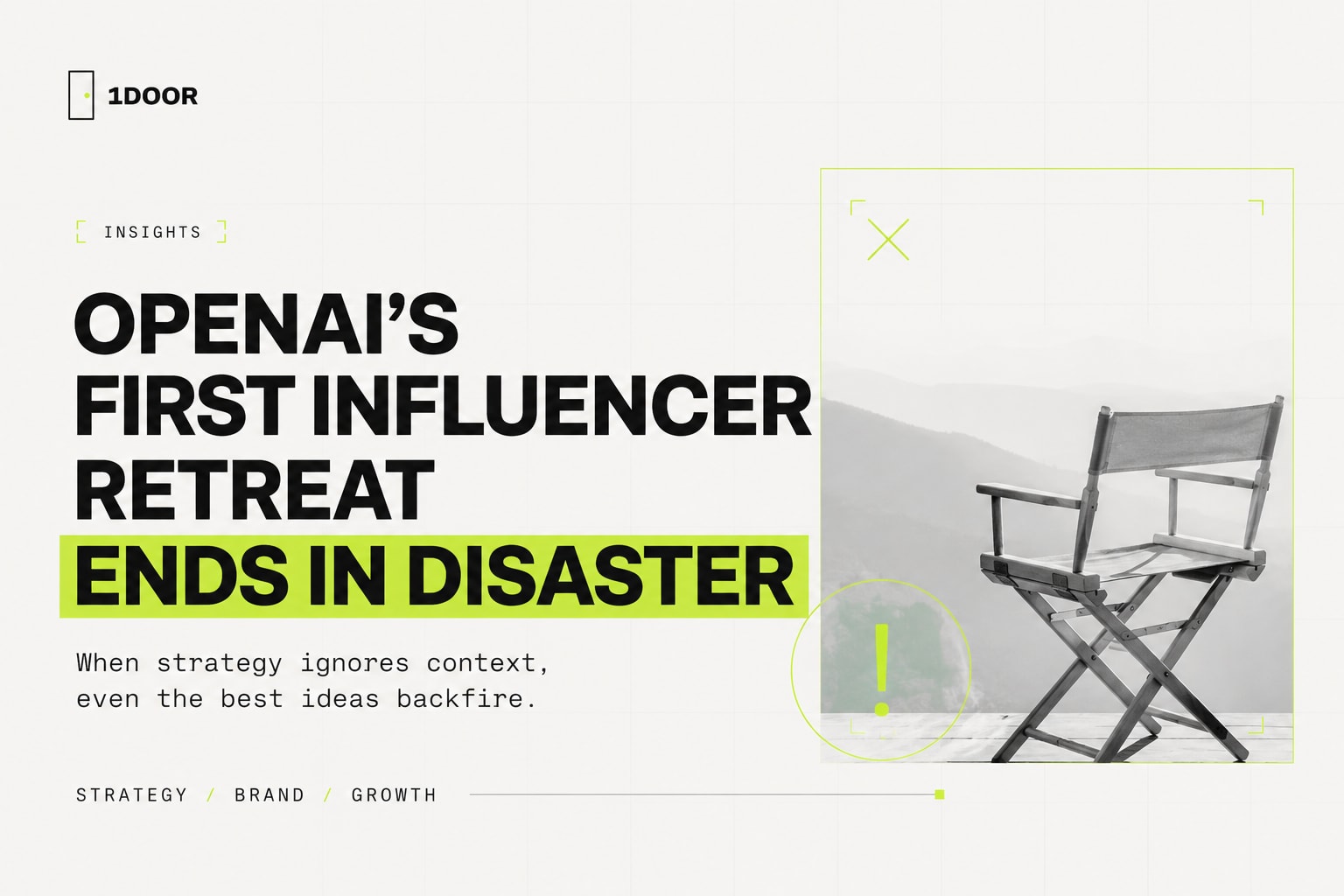
WHY MARKETING CAMPAIGNS FAIL NOT BECAUSE OF WEAK CREATIVE, BUT BECAUSE OF THE WRONG STRATEGIC CONTEXT
Marketing is often evaluated by the strength of its creative idea. How visually appealing a campaign is. How willingly people share its content. How quickly videos and posts spread.
But in reality, the success or failure of most major campaigns is determined by something else.
It is determined by strategy.
OpenAI’s recent controversy is a good example of why these two levels should never be separated.
For the first time, the company organized a full-scale influencer brand trip. Around thirty creators were invited to Wildflower Farms in New York’s Hudson Valley for several days surrounded by nature, workshops, farm-to-table dinners, creative activities, and an introduction to the new ChatGPT Work. From a marketing perspective, the idea was perfectly logical: give creators first-hand experience with the product so they could later demonstrate practical use cases to their audiences.
If you look only at the activation itself, everything appears to be well executed.
But the market rarely evaluates campaigns based solely on what the brand intended to communicate.
It evaluates them through context.
And that is exactly where the problem emerged.
While OpenAI was talking about productivity and the possibilities of artificial intelligence, the public conversation was increasingly focused on very different issues: the energy consumption of AI data centers, water usage, the environmental impact of AI infrastructure, new large-scale infrastructure projects, and the company’s cooperation with government institutions.
As a result, the audience did not see an educational program.
They saw a luxury eco-retreat organized by a company that, at the very same moment, was being widely discussed in connection with the environmental impact of artificial intelligence.
That is why the discussion in the comments quickly shifted away from ChatGPT Work.
Instead, people began talking about sustainability, resource consumption, the company’s reputation, and the credibility of the influencers participating in the event.
There is an important lesson here for businesses.
Marketing rarely becomes the cause of a crisis on its own.
More often, it becomes the point at which existing tensions surrounding a brand become visible.
That is why strong marketing teams evaluate more than just the creative idea.
They evaluate the environment in which that idea will exist.
Before launching any high-profile marketing activation, it is worth asking a few important questions.
- What is currently creating the greatest tension around the company?
- What criticisms is the audience already prepared to raise?
- Could the chosen activation reinforce those existing concerns?
- How will this campaign look not from the marketing team’s presentation, but through the eyes of a critic?
- Are the brand and the campaign participants prepared to answer difficult questions—not just showcase branded gift bags and jars of honey?
These questions often have a greater impact on the outcome than production quality or campaign budget.
At 1Door, we often say that marketing cannot be viewed separately from the business.
Every piece of communication becomes an extension of the company’s strategy. It either reinforces existing trust-or highlights contradictions that have already accumulated.
That is why great marketing does not begin with searching for a beautiful idea.
It begins with understanding the story the market is already telling about your brand.
If the strategy takes that context into account, creativity becomes a powerful amplifier.
If it does not, even the most beautiful campaign can become the reason people discuss everything except the message the brand wanted to communicate.
Comments
No comments yet. Be the first.