Imagine a business with excellent retention. Customers are happy, they come back, buy again, and churn is under control. Does that mean the company has a sustainable growth plan? The short answer is no.
This is one of the questions in 1 GAME that seems almost obvious until you start looking at the mechanics behind it. Retention is critically important: it affects LTV, acquisition payback, marketing economics and revenue predictability. But good retention answers the question of whether you can preserve the value you have already acquired. It does not answer another important question: where will the next wave of customers come from?
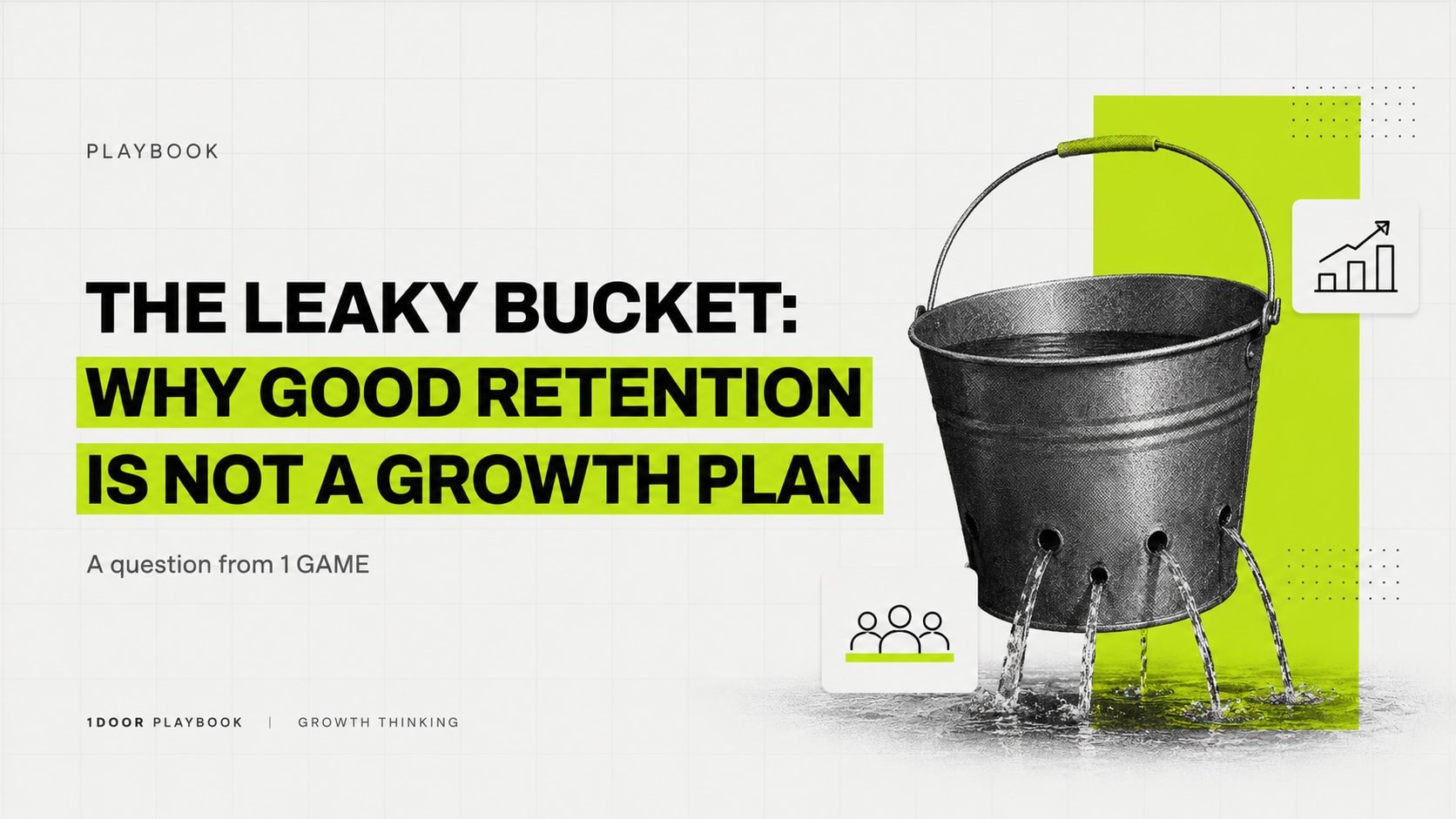
This is where the leaky bucket metaphor comes in.
LET’S START WITH THE BUCKET
The classic leaky bucket logic is simple. Imagine your business as a bucket of water. New customers flow in from the top, while some existing customers eventually leave through holes at the bottom. Acquisition fills the bucket; retention reduces the leakage.
If 10 out of every 100 customers leave each month, the business needs to acquire at least 10 new ones just to stay where it is. If only two leave, the situation is significantly better. But even if you manage to close almost every hole, water does not appear in the bucket by itself.
Retention reduces losses. Acquisition creates inflow. Sustainable growth requires both.
This distinction becomes especially important when a company starts confusing the efficiency of its existing customer base with its ability to scale.
GOOD RETENTION CAN CREATE A VERY COMFORTABLE ILLUSION
A business with high retention genuinely has a lot going for it. Repeat purchases are strong, LTV is high, CRM metrics look healthy, loyal customers generate a stable share of revenue, and the company can afford a longer acquisition payback period.
At this point, it is tempting to decide that marketing should simply focus on the existing customer base. Why aggressively look for new customers if current ones are happily coming back?
The problem is that almost every market and every customer base has a limit. Some customers will leave anyway. Their needs may change, they may move, find an alternative or simply stop needing the category. Purchase frequency cannot increase forever either. Someone buying coffee four times a week is unlikely to start buying it forty times just because the brand has excellent CRM.
Eventually, you reach the natural ceiling of your existing audience. At that point, you may discover that the company has become very good at retaining customers without ever building a reliable mechanism for acquiring new ones.
RETENTION IS A MULTIPLIER, NOT THE ENGINE
One useful way to think about retention is not as an independent source of growth, but as a multiplier of acquisition efficiency.
Imagine two businesses acquiring 1,000 new customers every month. In the first, most customers make one purchase and disappear. In the second, a significant share stays, comes back and increases their lifetime value.
Obviously, the second business will build a much larger customer base over time and can afford a higher CAC. The same flow of new customers creates completely different long-term value.
But if the second business stops acquiring those 1,000 customers, good retention will not create them out of thin air.
So the useful question is not, “Which is more important: acquisition or retention?” That is a false choice. A much better question is: how effectively does our system turn an acquired customer into long-term value, and how predictably can we bring in the next one?
THE PROBLEM STARTS WHEN COMPANIES OPTIMISE ONLY ONE SIDE
Some businesses are literally pouring water into a leaking bucket. They keep increasing advertising budgets, buying more traffic, scaling performance marketing and launching new channels, while barely investing in product quality, service, repeat purchases or customer experience.
CAC rises, churn remains high, and marketing has to acquire more and more people just to compensate for those who have already left. That is a bad model.
But the opposite extreme exists too. A company can become so focused on its existing customer base, loyalty, CRM and retention that it gradually stops creating new demand.
The bucket no longer leaks, but the tap is closed too.
That is not a growth strategy. It is highly efficient management of the business you already have.
WHY LOOKING AT PERCENTAGES ALONE CAN BE DANGEROUS
Retention rate by itself can easily be misleading.
Imagine a small SaaS product with 100 customers and 95% retention. That is a genuinely good result. One month later, 95 customers remain.
Another product has 10,000 customers and 90% retention. The percentage looks worse, but the absolute scale of the business is completely different.
Now add acquisition. The first product brings in five new customers per month; the second brings in two thousand.
Looking only at retention and using it to judge the health of the business makes little sense. We need to see the movement of the entire system: how many customers arrive, how many stay, how many leave, how many return, how much each cohort generates and how acquisition economics change over time.
Retention percentage shows the quality of one part of the system. Growth shows the dynamics of the whole system.
WHAT ABOUT REFERRALS?
There is an obvious counterargument: happy, loyal customers can bring in new customers themselves.
Absolutely. That is exactly why referral and word of mouth are so valuable.
But at that point, retention is already working together with acquisition. The customer is not simply staying; they are becoming an acquisition channel.
That distinction matters.
A strong product can create organic growth loops: someone gets value, stays, tells another person about the product, that person joins, gets value too and brings in someone else.
For some products, this mechanism becomes incredibly powerful. But it still needs to be understood, measured and strengthened. Simply hoping that “happy customers will eventually tell their friends” is not a growth strategy.
GROWTH IS A SYSTEM OF FLOWS
At 1Door, we prefer to look at marketing not as a collection of isolated channels, but as a connected system.
Acquisition brings the customer in. Activation helps them experience the first meaningful value. Retention gives them a reason to stay. Revenue turns that relationship into sustainable economics. Referral can feed some of that value back into acquisition.
When one element fails, pressure shifts to the others. Poor retention forces the business to constantly buy new customers. Weak acquisition limits even a brilliant product to a small existing audience. Poor activation turns paid traffic into people who never understand why they need the product in the first place.
This is why trying to identify one single “growth metric” often leads in the wrong direction. You need to understand how customers move through the entire system.
FIX THE LEAK BEFORE YOU TURN UP THE TAP
The leaky bucket metaphor sometimes leads to the wrong conclusion: first achieve perfect retention, then start investing in acquisition.
In reality, that perfect moment may never come.
But the principle is still useful. If there is a massive leak, endlessly compensating for it with advertising spend makes little sense. First, you need to understand why people leave. Is the problem the product, onboarding, pricing, service, expectations, audience quality or the value proposition itself?
Once those issues are addressed, acquisition becomes much more efficient because every new customer has a better chance of staying and generating long-term value.
But eventually, you still need to turn up the tap.
Because retention protects growth, but it does not replace it.
WHAT TO CHECK IN YOUR BUSINESS
If your retention numbers look strong, the next conversation inside your team should go beyond celebrating the metric. Ask whether the absolute number of active customers is growing or only the percentage that stays; where new customers come from and how predictable those channels are; what happens to CAC as you scale; how much growth comes from new customers, repeat purchases and referrals; whether your existing customer base has a natural ceiling for purchase frequency or volume; what happens to the business in a year if acquisition remains at its current level; and whether retention creates actual growth loops or simply reduces churn.
If you cannot answer most of these questions, high retention is good news, but it is not yet a strategy.
THE BUCKET NEEDS MORE THAN FEWER LEAKS
Good retention is one of the best things that can happen to a company’s economics. It increases LTV, reduces dependence on constantly buying traffic, improves acquisition payback and makes growth more sustainable.
But retention preserves what has already entered the system.
For a business to grow, something new must continue entering it: new customers, new segments, new use cases, new markets or new sources of demand.
The goal, therefore, is not to choose between acquisition and retention.
Build a bucket that barely leaks, and at the same time understand where an increasing flow of water will come from.
That is when you have a growth plan.
1Door Playbook - we break down marketing frameworks, questions from 1 GAME and business mechanics that are worth understanding not just as terminology, but as tools for making better decisions.
Comments
No comments yet. Be the first.