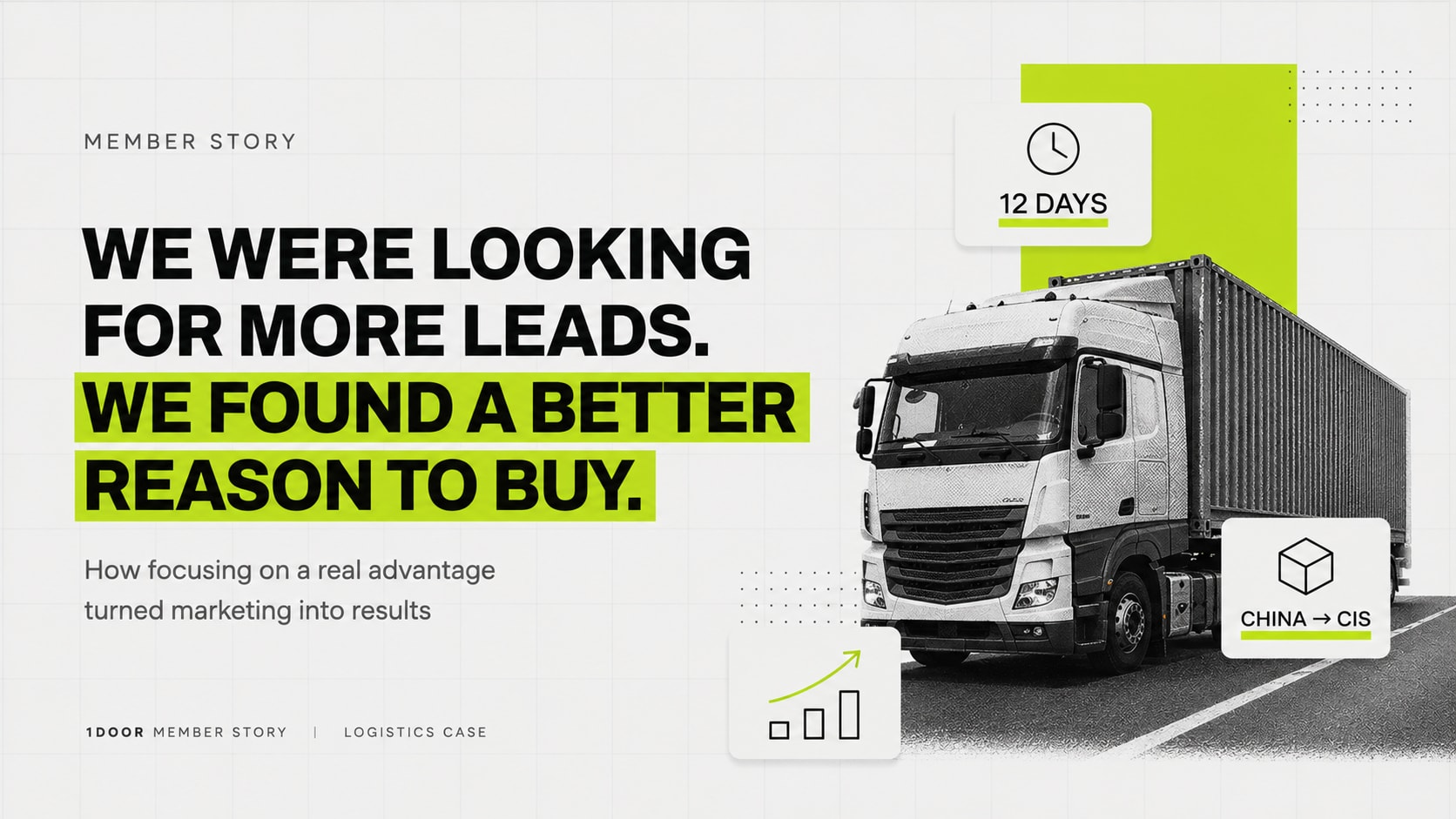
Sometimes the best way to improve lead generation is to stop touching lead generation. In this Member Story, we look at an international logistics case where growth did not start with a new ad account, but with one simple question: what is the customer actually buying here?
The initial brief sounded extremely familiar: a company handling international logistics from China to CIS markets needed more leads.
The obvious next steps would have been equally familiar: increase the advertising budget, rebuild the landing page, create new banners, test a few additional channels and then spend the following weeks discussing why there still were not enough leads, or why the leads were somehow “wrong”.
Instead, the team started with something more fundamental: what exactly is the company selling, and why should a customer choose it over another logistics provider?
The answer ended up changing the entire marketing system.
THE PROBLEM WAS NOT THE LACK OF AN ADVANTAGE. THE BUSINESS JUST DID NOT TREAT IT LIKE ONE
The company already had a strong product advantage: it could deliver consolidated cargo from China in approximately 12 days.
Internally, this was treated almost like an operational detail. The company could do it, the team knew it, and nobody considered it particularly remarkable.
For the customer, however, the situation looked very different.
If the goods are sitting in China while sales depend on them reaching a warehouse in the CIS, every additional day can mean frozen working capital, delayed supply, stock shortages and lost revenue.
In that context, speed stops being a logistics feature and becomes a very specific business value.
The problem was not that the product had no competitive advantage. The business simply was not using that advantage as a reason to buy.
FROM “RELIABLE LOGISTICS” TO A CLEAR PROMISE
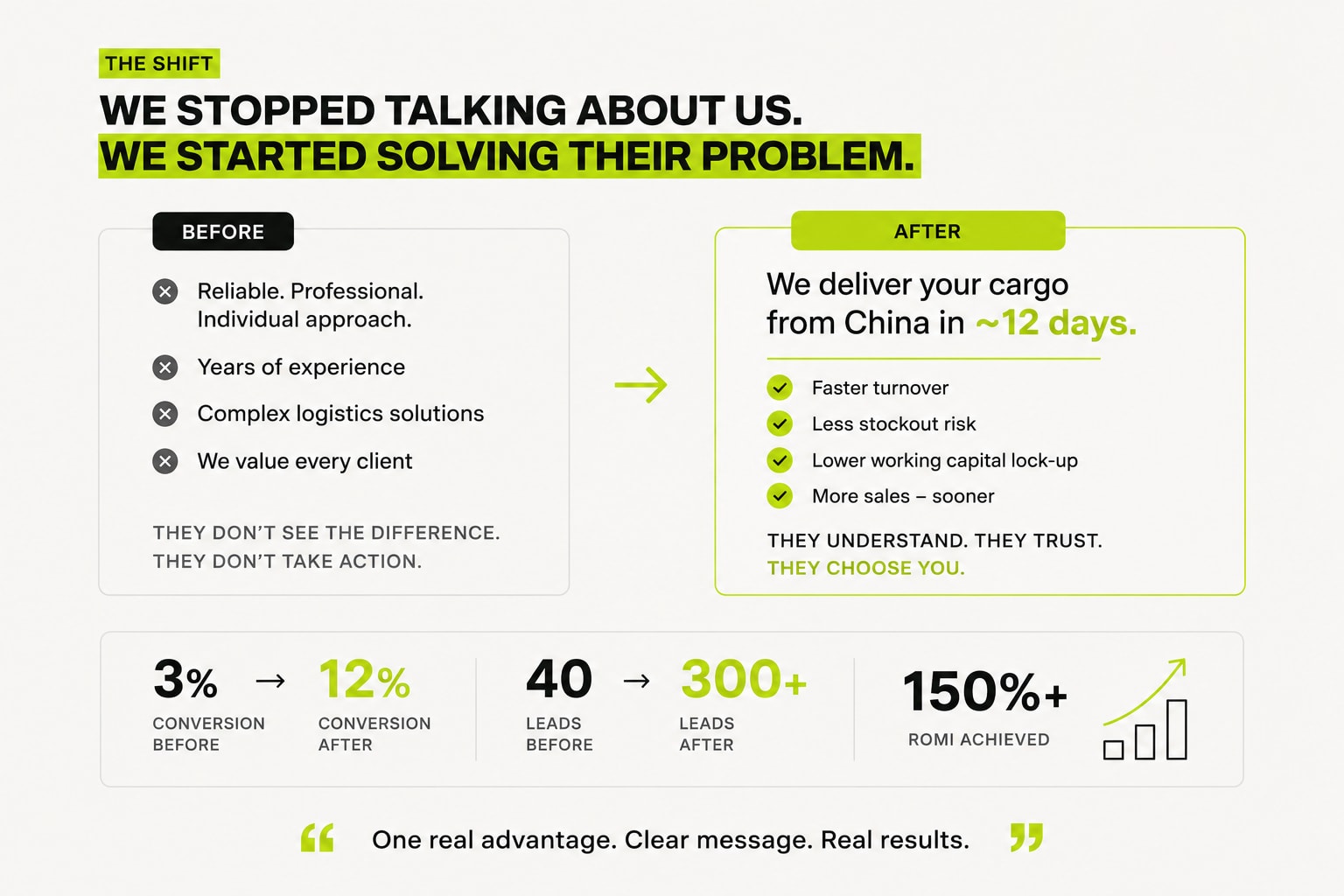
B2B communication has a habit of drifting into safe language: reliability, quality, professionalism, individual approach, years of experience.
Most of those claims may be true. The problem is that competitors usually say exactly the same thing.
So instead of creating another polished version of standard logistics messaging, the team moved one concrete proposition to the centre of the offer: express delivery of consolidated cargo from China in approximately 12 days.
From there, the rest of the system was rebuilt around that one advantage: landing pages, advertising messages, creatives and lead generation mechanics.
Marketing stopped trying to explain that this was a good logistics company. Instead, it started answering a much more practical customer question: how can I get my goods from China faster and put them back into commercial circulation?
The numbers changed together with the communication.
WHAT CHANGED
After the offer and advertising communication were rebuilt:
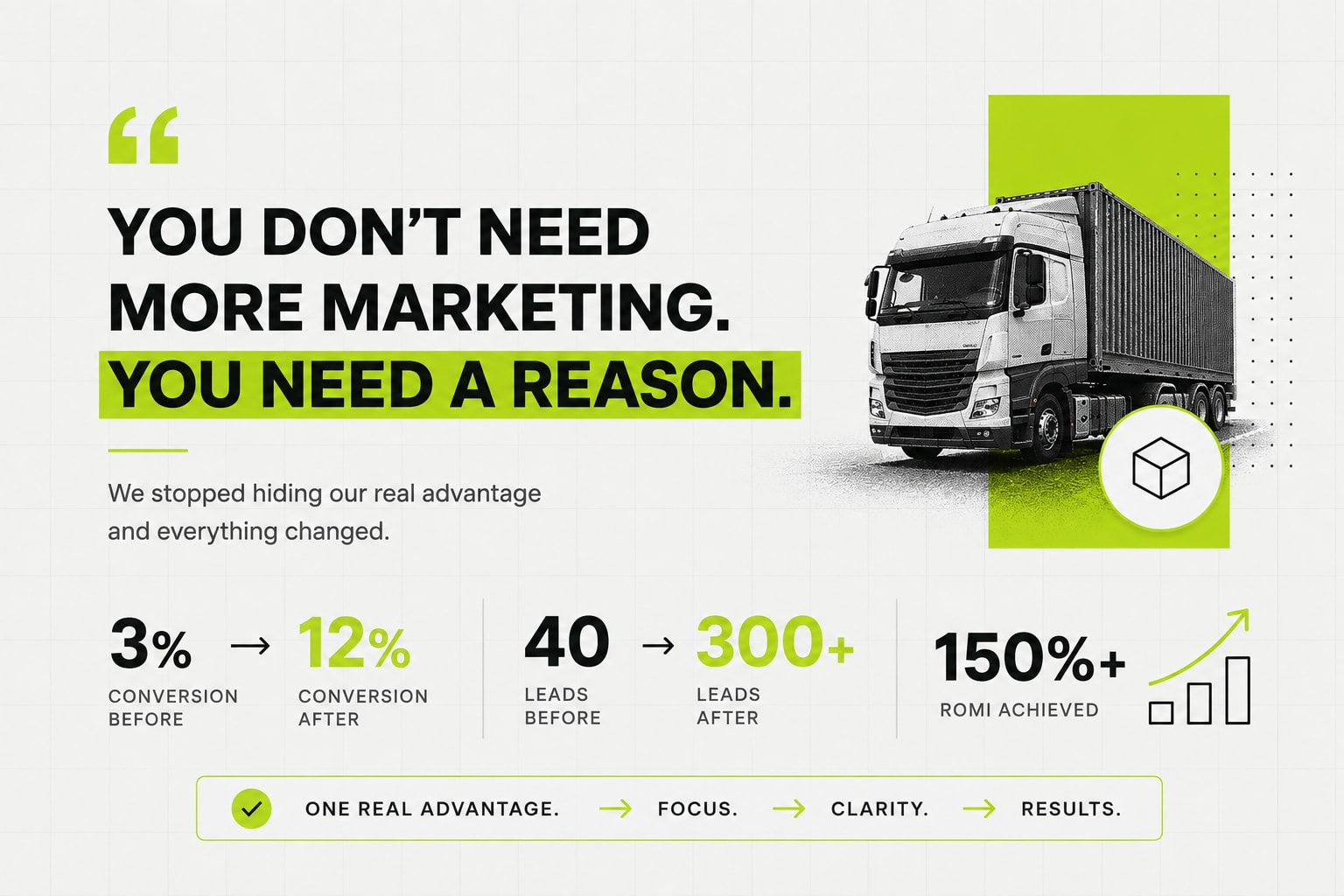
- conversion increased from 3% to 12%;
- the number of leads grew from 40 to 300+;
- ROMI exceeded 150%.
In other words, conversion increased roughly fourfold, while lead volume grew more than seven times.
The key change did not happen inside the advertising platform. There was no secret targeting setup, new ad format or hidden acquisition channel that competitors had somehow missed.
What changed was what marketing was actually asking people to buy.
WHY IT WORKED
Because strong performance marketing cannot compensate for a weak proposition.
You can perfectly target the right person, bring them to the right page at the right moment and still lose them if they cannot understand within seconds why the offer matters or how it differs from alternatives.
At that point, marketing simply becomes very efficient at buying confusion.
And the better the acquisition system is, the faster it scales that confusion.
This is why reducing CPL or increasing CTR should not always be the first objective. Sometimes it is more useful to move one level higher and ask whether the acquisition system has a strong signal to amplify in the first place.
In this case, that signal was 12 days.
BEFORE YOU CHANGE THE CHANNEL, CHECK THE OFFER
When marketing underperforms, the reaction often starts with the tool.
Ads are not working, so change the creatives. Not enough leads, so increase the budget. Low conversion, so rebuild the landing page. Social media is not growing, so find a new content format.
All of those decisions can be correct, but only after the business has answered a few more fundamental questions.
What are we actually selling?
Why does the customer need it?
What business problem does the product solve?
Why should the customer choose us?
Do we have a real advantage, and do we actually understand what it is?
That last question matters more than it sounds.
Strong advantages do not always appear after a major strategy workshop. Sometimes they sit inside the product for years and become so normal to the internal team that they stop feeling valuable.
To the customer, that same “ordinary” capability may be the main reason to choose the company.
NOT EVERYTHING NEEDS TO BE INVENTED
Marketers are trained to look for what is new, and the industry constantly reinforces that instinct. New channels, tools, AI services, formats, mechanics and optimisation methods appear all the time.
This creates the impression that growth must come from the next new thing.
But sometimes the strongest marketing move already exists inside the business. It does not need to be invented. It needs to be identified, translated from product language into customer value and made visible enough.
In this logistics case, the company had already been able to deliver cargo in 12 days before the marketing work started. Marketing did not create that advantage.
It made sure the market finally noticed it.
PLAYBOOK: WHAT TO TAKE FROM THIS CASE
Before the next round of optimisation, start by reviewing the product and identifying features the business considers normal but the customer may see as valuable. Then translate those features into customer outcomes: not “12-day delivery”, but less frozen capital and a faster return of goods to sales.
Next, compare the proposition with the market. If you remove the logo, is there still a clear reason to choose you, or could the same text sit on almost any competitor’s website?
Only then should you build communication around the strongest argument and move on to optimising channels, performance marketing, CRM, SMM and landing pages.
The order matters.
First, create a reason to buy. Then optimise how efficiently you deliver that reason.
In this case, one shift in proposition logic was enough to increase conversion from 3% to 12%, grow lead volume from 40 to 300+ and push ROMI above 150%.
Sometimes growth does not start with the question, “How do we get more leads?”
It starts with a much more uncomfortable one:
Why should those leads choose us at all?
1Door Member Story - real cases from community members, where we look not only at the result, but at the decision that created it.
Comments
No comments yet. Be the first.