For a long time, it was convenient for businesses to think of the customer as someone moving through a clear funnel: saw an ad, became interested, clicked, submitted a request, bought, returned.
It looks neat on paper. It looks neat in reports too. In real life, however, customers tend to behave much less predictably.
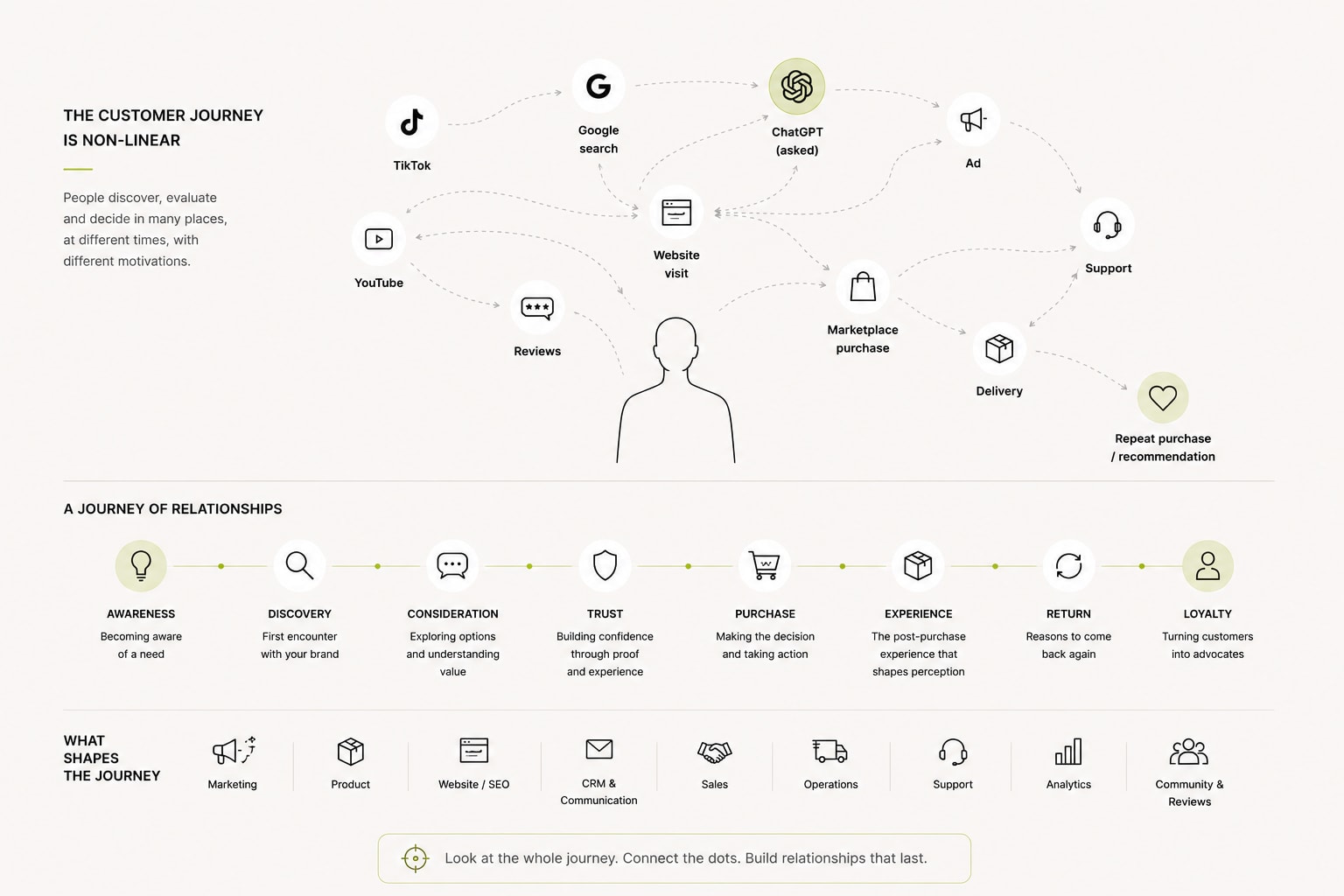
Someone might first hear about a brand on TikTok, then see a review on Google, then ask ChatGPT, then visit the website, leave, see an ad later, read some reviews, buy through a marketplace, contact customer support, get disappointed with the delivery, and never come back.
Or the opposite: they might not buy immediately, but return three months later through branded search because somewhere along the way, trust has already been built.
That is why, in 2026, simply building a funnel is no longer enough.
What matters is understanding the entire relationship journey between a business and a person.
Not only where the customer clicked, but where they first discovered the brand, where they understood it, where they started to trust it, where doubts appeared, where they got lost, where they decided to buy, what experience they had afterwards, and why they eventually came back — or left.
HOW DID WE GET HERE?
At first, businesses mainly thought in terms of CRM: collect customer data, store interaction history, manage sales, segment the customer base, and send communications.
This was an important step because the customer stopped being just a “purchase” and became a person with a history of interactions.
Then the focus shifted toward CEM and CXM: customer experience management. Businesses began looking not only at the fact of a sale, but at the customer’s experience across every touchpoint.
Not simply “we sent an email,” but “what did the person feel, understand, and do after receiving it?”
In the classic customer experience logic, the goal is not only a satisfied customer, but also loyalty, repeat choice, and recommendations to other people.
Then more sophisticated approaches emerged: customer journey mapping, omnichannel, lifecycle marketing, community-based marketing, brand experience, customer success, loyalty ecosystems.
The names are different, but the idea is the same: the customer journey stopped being linear.
It became a network of touchpoints, contexts, expectations, emotions, channels, and internal business processes.
And now another layer has been added: AI search and AI assistants.
This changes the very moment of discovery.
A person may discover a brand not through an advertising banner or even a traditional search result, but through an assistant’s answer.
A 2026 study on the impact of AI brand recommendations shows that when a conversational assistant recommends a brand to a user who has not recently interacted with it, this is associated with an increase in branded Google searches, visits to the brand’s website, and visits to branded pages on retailer websites.
At the same time, traditional last-click analytics often fails to capture this upper-funnel touchpoint because the journey is ultimately attributed to search or another channel.
In other words, the customer journey has become even less visible to traditional reporting.
And even more important for the business.
WHERE CJM BREAKS: PUBLIC EXAMPLES
One of the most telling examples from recent years is Sonos.
In 2024, the company launched a completely redesigned app, but users encountered bugs, degraded system performance, and the disappearance of familiar features.
The problem was not simply a “bad app.”
For Sonos, the app is a critical part of the product: people use it to control their speakers, music, rooms, and familiar everyday routines. When this layer broke, it was not a single touchpoint that failed — the customer’s entire daily experience was disrupted.
The Verge covered in detail how the update damaged the brand’s reputation, and in 2025, CEO Patrick Spence stepped down amid the aftermath of the launch.
This is a good example of a broken CJM: the business may have thought it was launching a new digital product, while the customer felt that control over a familiar experience had been taken away.
Another example is Hertz and its attempt to rapidly scale its EV business.
The company made major announcements about purchasing large electric vehicle fleets, including Teslas, but in 2024 decided to sell a significant portion of its EV fleet and shift back toward more gasoline-powered vehicles due to weak demand, high repair costs, and residual value challenges.
Here, the CJM does not break in advertising or PR.
It breaks at the level of actual use.
The customer needs to understand where to charge the car, how to plan the route, what the costs will be, how convenient it is to rent an EV, and what happens in the event of damage or repairs.
If the operating model, infrastructure, and customer expectations are not ready, a beautiful electrification strategy turns into a complicated customer experience.
A third example comes from e-commerce and startups.
A 2026 study of startup visibility in LLM search revealed an interesting gap: when AI models were asked about products by name, they recognized them almost every time. But in discovery queries such as “best AI tools of the year,” visibility dropped dramatically.
For ChatGPT, the gap between branded and organic discovery queries was approximately 30 to 1.
This is an important signal for brands: having a website, a product, and content is no longer enough.
You need to be embedded in an ecosystem of trust, mentions, sources, communities, SEO, reviews, and proof. Otherwise, a person may be actively looking for a solution while your brand never even enters their consideration set.
In all three cases, the problem cannot be reduced to a single channel.
With Sonos, the product experience suffered. With Hertz, strategy collided with operational reality and customer habits. With startups in AI discovery, we can see that brand recognition by name does not equal presence at the moment of choice.
All of this is about CJM.
WHY THE FUNNEL IS NO LONGER ENOUGH
A funnel helps measure stages, but it often oversimplifies reality.
It says:
Awareness. Consideration. Conversion. Retention.
The actual customer says:
I saw it. I didn’t understand it. I forgot about it. I remembered it. I asked about it. I compared it. I didn’t trust it. I came back. I bought it somewhere else. I regretted it. I contacted support. I recommended it to a friend — or I never came back.
AI search makes this picture even more complex.
Google is developing AI Overviews and AI Mode, while 2026 research shows that AI Overviews are already triggered for a significant share of queries and appear particularly frequently for question-based searches. In one measurement, overall AIO activation was 13.7%, rising to 64.7% for question-form queries.
This means that part of the customer journey now happens before the click, before the website, before CRM, and before traditional analytics.
A person can receive a summary, comparison, recommendation, or advice directly within an AI interface, while the business may only see the later branded search or website visit.
That is why the question “Which channel generated the sale?” is becoming increasingly insufficient.
Better questions are:
Where did the person first understand our value?
Where did trust appear?
Where did they compare us with alternatives?
Where did we lose them?
Where did they find the proof they needed?
And what needs to happen for them to come back?
A SIMPLE FRAMEWORK FOR REVIEWING THE CUSTOMER JOURNEY
We look at the customer journey not as a funnel, but as a sequence of relationships.
Before brand awareness. How does the person first become aware of the problem or need?
First touchpoint. Where do they first encounter the brand, and what do they understand in the first few seconds?
Understanding the value. Can they quickly explain to themselves why they need it?
Trust. What proof helps them believe the brand?
Choice. Why should they choose you rather than a competitor?
Purchase. How easy is it to take action?
Post-purchase experience. What happens after payment, delivery, installation, or first use?
Return. Why should the person come back?
Loyalty. What turns a customer into a brand advocate?
The most important thing here is not simply drawing the map.
The most important thing is understanding which teams, processes, and decisions influence each stage.
Because the customer journey does not live only in marketing.
It is shaped by the product, price, website, app, CRM, support, delivery, retail, managers, content, reviews, product availability, warranty, community, and even the way a company explains its decisions publicly.
HOW 1DOOR HELPS
At 1DOOR, we do not look at one part of the funnel as an isolated problem.
If SMM is not converting, we do not look only at the posts. We look at what happens after interest appears.
If performance is expensive, we do not look only at bids and creatives. We look at the offer, landing page, trust, segments, and subsequent touchpoints.
If e-commerce is not growing, we do not look only at product listings. We look at assortment, reviews, stock, pricing, content, promotion, operational support, and repeat purchases.
Our sixth principle is simple:
We look at the entire customer journey, not just one part of the funnel.
This is especially important now, when one part of the journey may happen in AI search, another on social media, another in a community, another on a marketplace, another in CRM, and another in a conversation with a friend who has already had an experience with the brand.
1DOOR helps businesses see not only “where the metric dropped" but where the connection between the person and the company was broken.
And then we build a system where the brand, product, channels, team, and processes work together across that journey.
FURTHER READING
For AI search and its impact on brand discovery, see the study From Prompt to Purchase, which examines how AI assistant recommendations are associated with subsequent branded searches and website visits.
To understand Google AI Overviews, the study Measuring Google AI Overviews is useful for exploring activation frequency, sources, and the impact of AI-generated answers on the information ecosystem.
For a public example of a broken customer experience, read The Verge’s coverage of the Sonos app redesign.
For discovery in LLMs, see the research on Product Hunt startups and why recognition by name does not guarantee that a brand will appear in organic AI recommendations.
FINAL THOUGHT
The customer does not live in your funnel.
They live in their own context, their own doubts, their own habits, their own search queries, their own AI-generated answers, their own recommendations, their own purchases, and their own post-purchase experience.
A business can optimize an individual channel as much as it wants, but if the customer journey falls apart between touchpoints, there will be no result.
In 2026, the winner is not the company that builds the most beautiful funnel.
The winner is the company that builds a clear relationship journey between the business and the person.
This is the sixth principle of 1DOOR.
We look at the entire customer journey, not just one part of the funnel.
From the first touchpoint to loyalty.
From AI search to repeat purchase.
From the brand promise to the customer’s real experience.
Comments
No comments yet. Be the first.