There is a very appealing idea: if you bring enough strong people into a project, the result will automatically be strong.
So, a great marketer, a strong e-commerce specialist, an experienced strategist, a good performance lead, a smart analyst, a bold creative, and a manager who knows how to build processes all come together. The plan is simple: everyone steps in, does their part, brings their expertise, packages the solution — and surely, the business will start moving.
Everyone pulls. And pulls. And somehow, nothing moves.
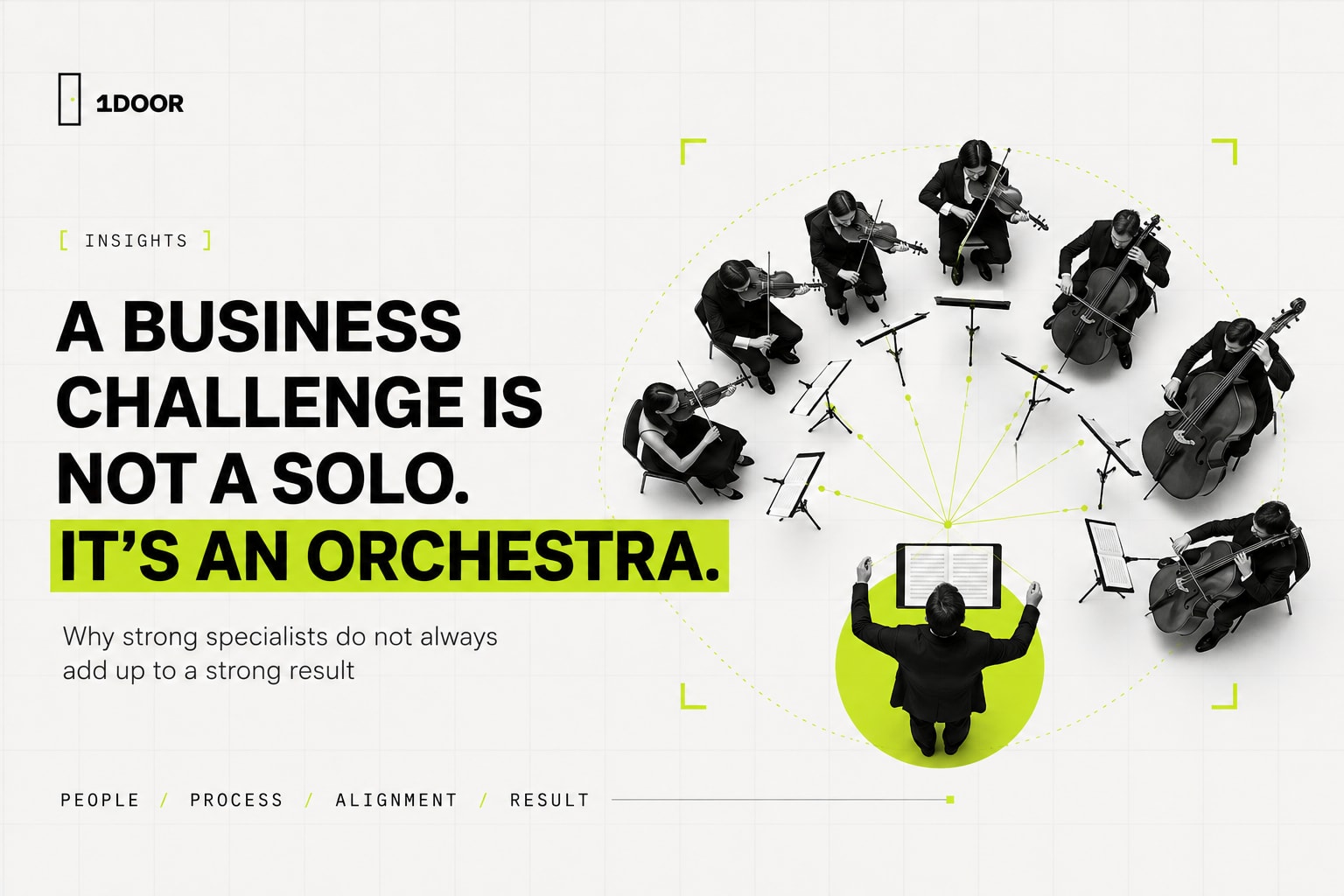
Because there is one uncomfortable detail in this logic: a business challenge is not a solo performance. It is an orchestra.
And if everyone is playing their brilliant part at a different tempo, all the client hears is noise.
WHAT IS THE PROBLEM?
Businesses often think they are missing a strong specialist, when in reality, what they may be missing is not talent, but alignment.
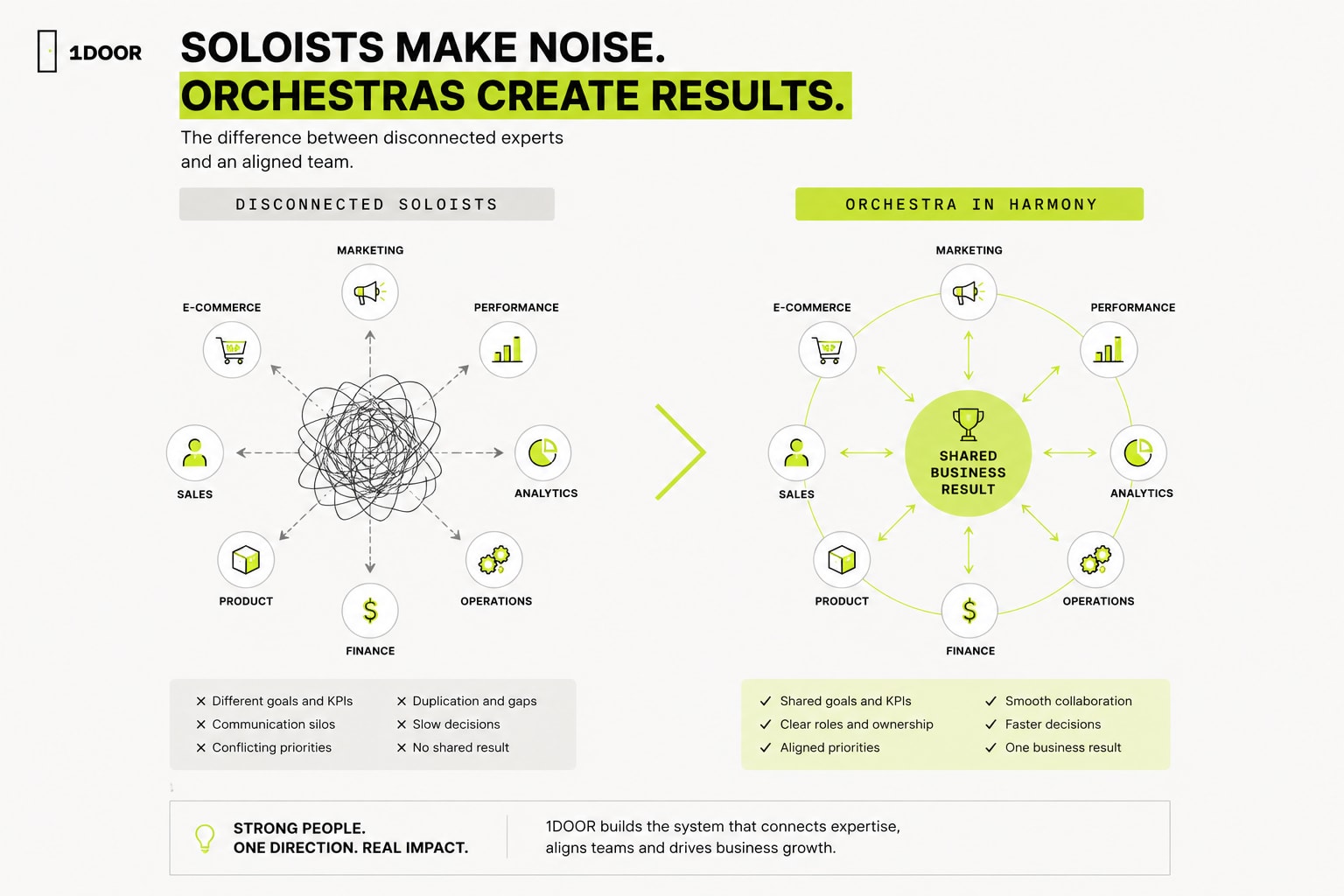
You can hire exceptionally strong people, but without a shared understanding of the task, clearly aligned roles, a common direction, and proper management, you do not get a team. You get a collection of soloists. Each of them will defend their function, their KPI, their expertise, and their own beautiful piece of work.
Marketing will talk about reach and positioning. Performance will talk about cost per lead. E-commerce will talk about product listings, conversion, and stock. Sales will talk about lead quality. Product will talk about product limitations. Finance will talk about margins. Operations will explain why none of this can be implemented quickly.
And the most interesting part is that they can all be right.
It just does not make things any easier for the business when everyone is right separately.
I have seen this happen in real projects: strong department heads genuinely do their jobs well, but there is no shared direction. Operationally, fires are being put out, reports are being completed, meetings are happening, everyone is busy — but the business itself is not developing because every department is pulling the task in a different direction.
In the end, everyone may walk away with a good individual case: marketing, sales, analytics, the contractor, the consultant.
But the business does not get the one case that actually matters: a solved problem and a clear result.
WHY THIS MATTERS ESPECIALLY NOW
Project models built around “stars” are particularly popular right now: bring in a strong consultant, creator, strategic partner, or contractor who comes in, creates an impressive solution, integrates their part, packages it beautifully into a case study, posts it on LinkedIn, and moves on.
From the outside, it looks impressive.
Inside the business, sometimes one question remains: what exactly are we supposed to do with all of this now?
The problem is not that these specialists are bad. Very often, they are genuinely excellent. The problem is that their work is not always integrated into the broader business mechanism.
Research into organizational communication demonstrates why this can be dangerous. An analysis of communications across more than 4,000 organizations and 360 billion email metadata records showed that after the shift toward more distributed ways of working, teams became increasingly isolated within their own groups: people communicated more frequently within their sub-teams and became less connected to other parts of the organization. The authors describe this phenomenon as dynamic silos.
For businesses, this means something very simple: even strong teams can lose effectiveness when there is no shared connection, context, and direction between them.
A similar principle lies at the heart of the concept of cross-functional teams. It does not simply mean “people from different functions sitting next to each other.” It means people with different areas of expertise working toward a shared goal.
A shared goal — not parallel individual tasks happening inside the same project.
WHERE PROJECTS BREAK
Projects usually break where there is no unified mechanism — even if the team is literally made up of “superheroes.”
For example, a business launches an advertising campaign.
At first glance, it needs a marketer or a performance specialist. But for the campaign to actually work, it also needs a clear product, a strong offer, the right price, a landing page, analytics, a sales process, CRM, product availability, logistics, and a team that understands what happens after the first customer interaction.
If everyone is responsible only for their own area, the campaign may look active without actually delivering results.
Another example: a business is developing e-commerce.
You can hire one person for product listings, another for advertising, another for content, and another for analytics. But if they are not connected through a single process, product listings will exist separately, advertising separately, stock separately, reviews separately — and KPIs separately from the customer’s actual reality.
Or imagine a brand building a new communication strategy.
You can create a beautiful strategy, visual system, and content. But if the product team, sales, customer support, and retail do not understand the promise the brand is now making to the market, that promise will never be delivered in reality.
This creates a strange effect: everyone did their job, but the customer still did not receive a coherent experience.
A QUICK “ORCHESTRA” TEST
Before assembling a project team of strong people, I would evaluate not only each participant’s expertise, but also how well the future system is capable of playing together.
Do all participants understand the business challenge in the same way?
Is it clear what counts as the shared result, rather than each specialist’s individual KPI?
Is there a person or process connecting the decisions of different experts?
Is it clear who makes the final decision when interests conflict?
Does each specialist understand what happens before and after their area of responsibility?
Is there one shared roadmap rather than a collection of separate departmental plans?
After external experts leave, does the business understand how to continue working with the result?
If there are no clear answers to these questions, you may not be assembling an orchestra.
You may simply be organizing a very expensive rehearsal of chaos.
HOW 1DOOR HELPS
At 1DOOR, we do not assemble a random group of strong people around a task. We bring together the expertise the task actually requires and build a unified process between those experts.
It is not enough for us to simply bring in a marketer, analyst, e-commerce specialist, strategist, project lead, or performance expert. What matters is that the product, team, channels, processes, and KPIs all work toward the same result.
No fragmentation. No tug-of-war. No situation where everyone delivers their own beautiful piece while the actual business challenge remains unsolved.
That is why our model values project management just as much as individual expertise: a shared goal, clear roles, a roadmap, synchronization points, decision-making, transferring the logic back into the business, and a clearly defined result.
Because strong people without a shared system can become just another problem for a business.
Strong people within a properly designed system become a mechanism for growth.
FINAL THOUGHT
Businesses rarely need another soloist.
More often, they need an orchestra that finally starts playing the same music.
This is the fifth principle of 1DOOR.
Different areas of expertise work as one mechanism.
Because results do not appear when everyone delivers their own brilliant part.
Results appear when all those parts start working together.
Comments
No comments yet. Be the first.