Automation You Don't Own Is Not a Saving. It's an Unpriced Risk.
Darya NikolaevaDigital Marketing · 10 September 2026
Here is a question that stops most teams cold: if one of your automations quietly stopped working today, how exactly would you find out?
Not "sales would notice". A mechanism.
The question is uncomfortable because borrowed automation almost never fails loudly. It keeps firing on schedule, keeps showing a green status, keeps reporting success — and does nothing. A step returns "no data", and "no data" is indistinguishable from "there was nothing to do today". Nobody gets paged. Nothing turns red.
Adoption, meanwhile, is no longer the interesting number. In McKinsey's State of AI global survey, 88% of organisations report regular AI use in at least one business function, up from 78% a year earlier. That part gets reported to the board. Ownership never does — and ownership is what decides whether anyone is watching.
Short version
Adoption has outrun ownership. Most companies now depend on workflows built by partners, agencies and contractors, running on accounts they cannot see into.
Borrowed automation rarely fails loudly. It reports success and does nothing — which is far more expensive than an outage, because an outage gets fixed the same day.
Three failure modes cover most of it: an expired credential inside a step, a disconnected pipe between two systems, and a dependency that disappears entirely. We found all three in our own stack. Details below, with numbers.
The cost is measurable before you fix anything. Three numbers you already have will tell you what a silent month is worth.
Listing your automations takes an afternoon. Verifying them does not, and that is the part almost nobody completes — because verification needs access you do not have.
The maths is unkind to inaction: six weeks of one silent enquiry path can cost several times what it costs to have the whole stack audited.
The number nobody puts on this
Start with the arithmetic, because it changes how urgent the rest of this feels.
Take the enquiry path — form to database to the board your salespeople actually open. Suppose it carries 40 enquiries a month, one in five becomes a customer, and a customer is worth $2,000. That path is worth $16,000 a month.
Now suppose the last step stops. Not the form — the form is fine, records keep landing in the database. Only the hop onto the board stops. Nothing alerts, because nothing crashed.
Revenue sitting unworked before anyone opens a log
$16,000 – $32,000
Realistically unrecoverable once it goes cold
$8,000 – $19,000
Put your own three numbers in. Volume, conversion, value. Multiply, then multiply again by six weeks — six is generous; the whole point of a silent failure is that there is no event to date it from. Note the second figure rather than the first: the enquiries are not destroyed, they are stale, and stale converts at roughly half the original rate. The unrecoverable half is the real number.
Then compare that figure to the cost of finding out. That comparison is the entire argument of this article, and for most teams it is not close.
And the wrong diagnosis costs separately: thin numbers read as thin demand, and thin demand gets answered with ad spend. That is how a plumbing problem gets a marketing budget.
Check now if any of this happened in the last 90 days
Silent failures cluster around changes of custody. If you recognise one of these, do not finish the article first.
A contractor, freelancer or agency stopped working with you. The single most reliable predictor of a pipe coming apart. Their accounts stay live for a while, then don't.
A subscription renewed, lapsed or was downgraded on any tool in the chain — including free tiers hitting a record limit.
A tool got consolidated or migrated, or a hosted project was reorganised.
A channel went quiet without an explanation you can name. Fewer enquiries, thinner candidate flow, a report that stopped landing.
Someone said "I think that's automated" and nobody in the room could say whose login it runs on.
That last one is not a joke. It is the finding, stated out loud.
Automation is now infrastructure, and infrastructure has owners
Ten years ago automation was a project. Someone proposed it, someone budgeted it, someone signed it off. Today it arrives sideways. A partner sets up a workflow because it was faster than explaining the process. An agency wires your contact form to a CRM during onboarding. A contractor connects the translation step for the blog and moves on to the next client.
None of that is a mistake — it is how teams actually move. But each step becomes infrastructure: plumbing your revenue runs through, with no owner on your side, no documentation and no alarm bell.
The gap is not technical. Adoption gets reported to the board; ownership never does. You will know what share of your processes are automated. You will not know whose login they run under, or which of them a departing contractor still controls.
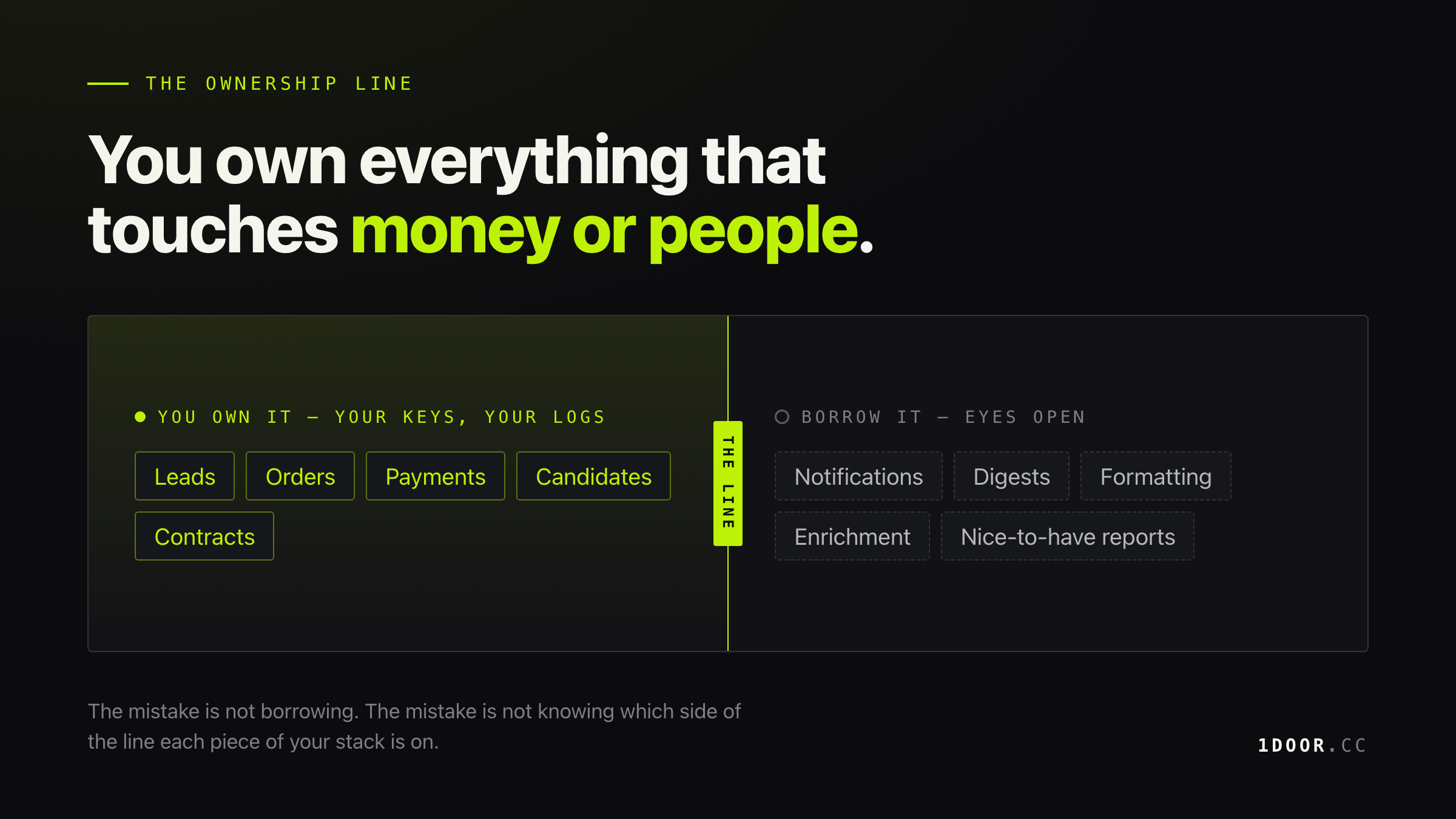
The ownership line: what you own, what you can borrow.
The three ways borrowed automation fails
These are not research categories. They are what the audit actually turns up, in stack after stack — including our own, which we put through the same quarterly check we run for clients. Three shapes, over and over.
The expired credential
Automation platforms keep API keys inside individual steps, not in one place you can review. When a key expires, the workflow still fires on schedule, still shows as active, and still completes. It simply fails at one node, on every run, until somebody opens the execution log.
Nothing turns red, because from the platform's point of view nothing crashed. The step returned no data. And "no data" is indistinguishable from "there was nothing to do today" — which is the normal state of most automations most days.
This failure mode survives longest, because every signal you would normally trust — active status, on-time runs, no error notification — says the system is fine. Detection requires opening a log you have no reason to open.
What the check catches. Our blog pipeline had a translation step on a third-party automation platform, holding a translator credential we could not see. The credential expired. The workflow kept running green and returning nothing, so the English versions of new articles simply stopped appearing. No error, no notification, no drop in any dashboard we were watching — the pipeline's own status page said healthy throughout. We found it by opening an execution log for an unrelated reason.
The disconnected pipe
Most automations are a chain of at least two moves: record the thing, then put it in front of a human. A form writes an enquiry into a database, and a second step creates a card on the board the sales team actually opens each morning.
When the second move stops, the first keeps working perfectly. Records accumulate where nobody looks. The board stays empty — and an empty board does not read as "broken", it reads as a slow month.
That is how a plumbing problem gets diagnosed as a demand problem.
What the check catches. Enquiries from our site were landing correctly in the database and were not reaching the CRM board. Seventeen of them, thirteen through a single form that nobody had connected onward. Every individual component worked. The form validated, the record saved, the confirmation went out. The only broken thing was the last hop, and the only symptom was a board that looked like a quiet period. We now create the CRM task from our own code, on our own keys, with a log we read.
The vanished dependency
Hosted databases, storage buckets and project spaces can disappear rather than degrade. A plan lapses, a project is deleted, an account is reorganised — and the address stops resolving altogether.
The application on top keeps loading; the list is simply empty. Every user assumes the data was never entered — and the people who would have noticed its absence are the ones who trusted the tool to hold it.
What the check catches. A recruiting tool we built stored its candidate pool in a hosted database. The database was removed — the hostname stopped resolving entirely. The app still loaded, still authenticated, still rendered its screens. The shared talent pool was simply empty, and an empty pool reads as "nobody has added candidates yet". It was not the application that failed. It was a dependency that stopped existing, with no event anywhere in our own systems to mark it.
Three different tools, three different owners, one shared property: each of them reported success while doing nothing.
Loud failures and silent ones
The distinction that matters is not "big" versus "small". It is whether the failure announces itself.
Fails loudly
Fails silently
Website down — customers call within minutes
A step returns "no data" for weeks
Payment declined — the provider emails you
A lead lands in the database but never on the board
Login broken — your own team is blocked
A translation or enrichment step stops, output just gets thinner
Invoice unpaid — a human chases you
A hosted dependency disappears and the list looks empty
Everything in the right-hand column shares one property: the only person who can detect it is whoever thinks to check. Nothing in your normal working day will surface it.
That is why the useful question about any automation is not "does it work?" but "if it stopped, how would I find out?"
What "free" automation actually costs
Automation running on an account you don't control looks free because no invoice arrives. The bill lands somewhere else: you cannot see which credential expires next month, you cannot add alerting to a workflow you cannot edit, and you inherit a roadmap set by someone whose plans have nothing to do with you.
But the expensive one is subtler. You lose the ability to read your own numbers. An empty board is a fact. "We have no leads" is a conclusion. The distance between the two is where a quarter's budget goes to solve the wrong problem.
The part you cannot do from the inside
Listing your automations is easy and you should do it today. Verifying them is a different job, and it is where self-audits stop — not from lack of discipline, but for three structural reasons.
You cannot inventory what you were never told about. A self-audit surfaces the automations you remember. The dangerous ones are the ones set up as a convenience, by someone who has since moved on, and never written down anywhere. There is no list to consult; they have to be found from the outside in, by tracing each business outcome backwards to whatever produces it.
Verification requires access you do not have. Confirming a credential is alive means opening the execution log of a workflow on someone else's account. Confirming a hosted dependency still exists means resolving its address. Confirming a pipe is connected means counting the same thing at both ends. None of that is visible from the dashboard you are allowed to see.
The person who knows is the person with the least incentive to volunteer it. Not through bad faith — nobody hides a workflow deliberately. But "which parts of your process run on my login" is a question people answer accurately when it is asked precisely, by someone who already knows what to ask, and vaguely when it is asked in passing.
This is the honest reason an outside audit is worth paying for, and the honest limit of the checklist below. The checklist will give you the list. Someone has to go and check.
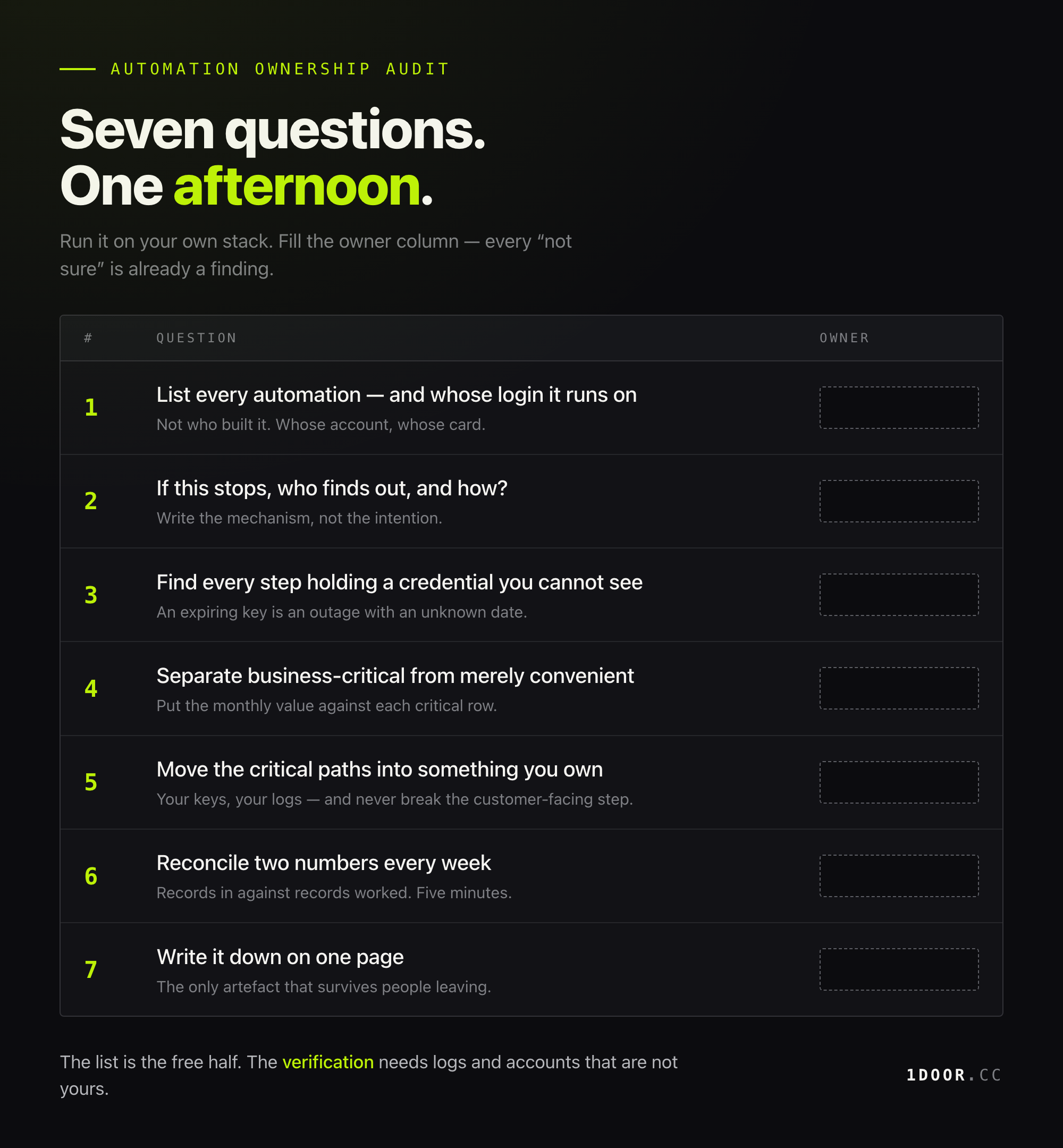
The audit, in seven questions
Run this on your own stack. It takes an afternoon, and it is uncomfortable in a useful way.
1. List every automation and write down who owns the account
Not who built it — whose login it lives under, and whose card pays for it. Include the boring ones: form notifications, scheduled reports, translation and enrichment steps, backups, chat alerts. Expect the list to run two to three times longer than the one in your head — that gap is the first finding.
Good looks like: one page, one row per automation, an owner name in every row. Any row where the owner column says "not sure" is already a finding, and you do not need to resolve it before moving on.
2. For each one, answer: if this stops, who finds out, and how?
Write the actual mechanism, not the intention. "Sales would notice" is not a mechanism. "The daily card count is compared against the database and a mismatch pings the channel" is.
If the honest answer is "nobody, until a client complains", that is your first fix — before any new automation.
3. Find every step holding a credential you cannot see
Every expiring key inside someone else's tool is a scheduled outage with an unknown date. You do not need to move all of them. You need to know they exist, and which of them sit on paths that carry money.
4. Separate business-critical from merely convenient
A notification that doesn't arrive is annoying. A lead that doesn't arrive is revenue. A report that doesn't generate costs you an hour. A candidate pool that quietly empties costs you a hire.
Sort the list into two columns, and put the monthly value from the arithmetic above against each row in the critical column. That column is normally two or three rows long, which is what makes the next step affordable — and what tells you whether to do it yourself or have it done properly.
5. Move the critical paths into something you own
Your codebase, your repository, your keys. Less work than it sounds, because the logic already exists and only the last mile is borrowed: a form that already writes to your database needs one more call to create the card. An hour of work, and the path stops depending on anyone else's account.
Two rules make it durable: it must fail into a log you actually read, and a failure must never break the customer-facing part. The enquiry gets saved and the confirmation email goes out even if the CRM call fails.
6. Reconcile two numbers every week
Records in the source system against cards on the board. Enquiries submitted against enquiries worked. Articles published against articles distributed. Any gap is a broken pipe, not a slow market.
This single habit catches most silent failures, and it costs about five minutes. It is also the cheapest thing in this article, so if you adopt exactly one item, adopt this one.
7. Write it down
One page: what runs, who owns it, what breaks loudly, what breaks silently, and what the weekly reconciliation compares. That page is what turns the next audit from a day into twenty minutes, and it is the only artefact that survives people leaving.
The seven-question audit. Fill in the owner column.
Your first 30 days
Week 1. Build the inventory. Do not fix anything yet. The value of the list is in seeing its length.
Week 2. Answer question two for every row. Mark the ones with no detection mechanism. Put the monthly number against the critical ones. Then pick the single most expensive silent path and add the crudest possible check — even a manual comparison in a calendar reminder.
Week 3. Move one critical path into something you own. One, not all. Prove the pattern works and that the customer-facing side stays intact when the automation fails.
Week 4. Set up the weekly reconciliation and write the one-page document. Book the next review 90 days out.
No migration, no new platform, no budget request. What it does need is access — to the accounts, the execution logs and the people who set things up. That is where most teams stall, and it is worth knowing that in advance rather than in week three.
Where the line of ownership should sit
A simple rule holds up well: you own everything that touches money or people, and you can borrow everything else.
Leads, orders, payments, candidates, contracts — these run on your infrastructure, with your keys, failing into your logs. Notifications, digests, formatting, enrichment, nice-to-have reports — borrow freely, and accept that they will occasionally stop without telling you.
The mistake is not borrowing. The mistake is not knowing which side of that line each piece of your stack is on.
The uncomfortable part
None of this is caused by bad tools or careless people. The automations are built properly and do exactly what they were configured to do. The platform behaves as designed. The contractor delivered.
The problem is ownership. The process belongs to you, the infrastructure doesn't, and nobody wrote down where the line between them runs. That is not a technology failure — it is a management one.
We run this check quarterly, on client stacks and on our own, which is why the three shapes above are described from the inside rather than from a whitepaper.
If your marketing, sales or hiring depends on automation you did not build, you do not have an automation problem. You have an inventory problem — and until it is inventoried, you cannot tell the difference between a quiet market and a disconnected pipe.
What this looks like as a piece of work
Everything above is already a priced service line, not a bespoke engagement. Three of them are the audit, in ascending scope.
Digital Systems Audit — $1,200–$2,000, 12 days. We review every system in the chain — CRM, CDP, analytics, ad platforms, automation software and the integrations between them — establish what each one actually does as opposed to what it is assumed to do, and return a Systems Audit Report: what to keep, what to replace, what to integrate, what to retire. This is the ownership inventory with the verification step included, run from outside your assumptions.
Digital Audit & Discovery — $2,000–$3,000, 14 days. The wider version, and the right one if you have inherited automation from more than one partner. It includes team and agency interviews — which is precisely the part of question one you cannot run yourself: asking a current or departing contractor exactly which parts of your process live on their login. Output is a Discovery Report with prioritised gaps and a 90-day plan.
Operations & Process Audit — $1,500–$2,500, 12 days. The same discipline applied to the process rather than the tooling: where work stalls, which handoffs are silent, which steps happen twice. It comes with interaction flow diagrams, which is what makes an ownership map readable to people who did not build it.
Then, if you would rather the fixes were done than listed:
Workflow Automation — $1,200–$2,500. The critical paths rebuilt to run on your accounts and your keys, failing into a log you actually read, and never taking the customer-facing step down with them.
Process Design & SOP — $3,000–$5,000. Question seven done properly: the one page becomes documented procedure with roles, decision points and escalation paths — the version that survives the next handover.
Now put those figures next to the arithmetic at the top of this article. One disconnected enquiry path was worth $16,000 a month in that example; six weeks of silence left $16,000–$32,000 sitting unworked, of which roughly half never comes back. The audit that finds it costs $1,200–$2,000, once. That is the comparison, and for most teams it is not close.
The seven questions above are the free version, and you should run them this week regardless. If you want the verification done properly, build a scope at 1door.cc/shop — add the audit you want, send it, and a human replies within twelve hours. If your paths turn out to be connected, we will tell you so and it ends there. Nobody should buy a diagnosis of a system that is fine.
FAQ
How do I know if an automation is silently broken right now?
Pick the two numbers at either end of it and compare them for the same period. Enquiries in the database against cards on the board. Articles published against posts distributed. If the numbers disagree and nobody knew, you have your answer — and you have also just built your first reconciliation check.
Can't we just do this ourselves?
The list, yes — do it today, it is an afternoon and the seven questions above are all of it. The verification is the harder half: it needs execution logs and account access for tools that are not yours, and it needs somebody asking a departing contractor precise enough questions to get accurate answers. Most self-audits produce a good list and stop there, which leaves the actual risk exactly where it was. That is why our audit lines include agency interviews rather than only a systems review.
Should we stop using third-party automation platforms?
No. They are the fastest way to connect things, and rebuilding everything in-house is a bad trade. The rule is the ownership line: revenue and people paths on your own infrastructure, everything else borrowed with eyes open.
Whose job is this audit?
Whoever owns the outcome, not whoever owns the tooling. If leads are marketing's number, marketing needs to know how a lead reaches the board. Delegating that knowledge to whoever built the workflow is how the gap appears in the first place.
We are a five-person company. Is this overkill?
The opposite. Small teams run on more borrowed automation per person than enterprises do, and have fewer people who would notice a silent failure. The inventory takes an hour at that size — and a single disconnected enquiry path is a larger share of the pipeline than it would be anywhere else.
How often should we redo it?
Quarterly for the inventory, weekly for the reconciliation. And immediately whenever someone who set up a workflow leaves the project — that is the single most reliable predictor of a pipe coming apart.
Sources
McKinsey — The State of AI: Global Survey 2026 — https://www.mckinsey.com/capabilities/quantumblack/our-insights/the-state-of-ai

Comments
No comments yet. Be the first.