How We Built Our eCommerce Training, and Why Few Trainers Do It
1 DOOR TEAMStrategy & Consulting · 28 July 2026
Here is the test I run in the room. I open each module by asking the team what they already know about the topic, and the answers come back thin, including from teams that finished an expensive program from a global provider six months earlier. The material was fine. It just never attached to anything.
So we built our own eCommerce team training around a rule that sounds obvious and almost nobody operationalises: the session runs on the client's own data, or it doesn't run. Big providers can't do that at scale. A course sold to four hundred companies has to use examples that belong to none of them.
The room where the question gets asked. Every module opens with "what do you already know about this?" and the answer sets the day.
Why the knowledge from an ordinary training doesn't hold
People retain what connects to a task they already own. Ebbinghaus mapped the shape of this in 1885 and the workplace literature has been re-confirming it ever since: information with nowhere to land washes out within weeks. A 2025 review in the European Journal of Work and Organizational Psychology puts the emphasis squarely on the conditions around the training rather than the training itself.
Try it on yourself. If I explained how a liquid-fuel rocket engine works right now, in three weeks almost none of it would survive, because your brain has no file to put it in. Training built on someone else's brand examples does the same thing.
Knowledge with no application to your business does not convert into money.
The stakes have gone up in Australia specifically. Per the Australia Post 2026 eCommerce Report, 82% of Australian households shopped online in 2025, total online spend hit $82.6 billion (+14% YoY), and marketplaces alone took $18.9 billion of it. Online is now 24% of all retail spend. A team that guesses at marketplace economics is guessing on a quarter of the market.
This is the whole battlefield: one thumb, one product card, four seconds. Everything in the training points back at this screen.
What we audit before we teach anything
Every task in the session comes out of an audit we run before the session exists. We collect the company's context first: sites and channels, a team survey, internal playbooks, strategy decks, whatever reporting is actually in use.
Then we review four fronts (the shopper path, socials, marketplaces, analytics) following your brand's real buyer route. Search query, marketplace product card, reviews, and then the moment the buyer either converts or leaves for a competitor. We write down where the card loses points, where a promo eats margin, where a review has been sitting unanswered since March.
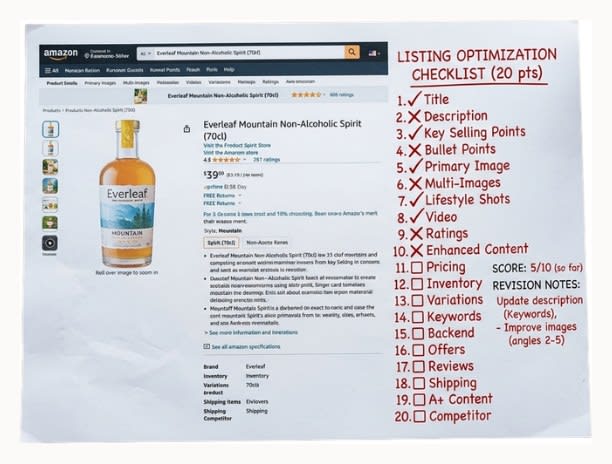
The card review is formalised, not impressionistic. Twenty points: main photo, SEO title, a photo carrying the key selling points, description, video, keywords, rich content, and at least five images at the required quality. One real card in a recent review scored 10.5 out of 20, which tells you both the size of the gap and the order of the fixes.
Nobody argues with their own screenshot. That is most of the value of doing the audit first.
The 20-point rubric, mid-review. Ten items scored, ten still open, and the revision notes already written in the margin. Nobody argues with their own card once it has a number on it.
Nine modules, one template, always adapted
The training runs from general to specific: company strategy down to the clauses of a marketplace contract. Every module ends in practice on your data.
The nine modules
The template is one. The session never is. We duplicate the master version and insert your brands, your products, your marketplaces, your org chart, your numbers, and only then run it.
The brand cases inside, and why each one is there
Each outside example illustrates exactly one mechanism the team then applies to its own product.
LEGO walks the shopper decision tree, showing how "who is it for" outranks age and theme, and what that means for merchandising. Mars shows how detailed instructions produce a predictable standard of execution. Apple and Xiaomi sit next to each other as opposite pricing strategies: premium discipline against volume on affordable quality. Tiffany demonstrates a price held up by brand strength rather than product uniqueness.
The Hershey's and Lindt experiment gets its own block. At 1¢ and 14¢, Lindt won 30% against Hershey's 8%. When Hershey's became free and Lindt dropped to 13¢, the split inverted. Value perception is non-linear, and the team sees that on numbers before it sees it in its own price list.
One of the slides that survives contact with the room. It is also, uncomfortably, why your product description is not being read.
The principal case study is always your brand, taken apart to the level of cards and contracts.
Practice: the team defends its decisions
Practice is built as a project defence. Group work against a clock, a flip chart, then a defence in front of the second group. Every task has to produce something usable by the end of the block.
Practice by module
After the promo-planning module, the team locks the knowledge in by building you a real quarterly promo calendar. Not a template. Theirs.
The money module, where the room usually goes quiet
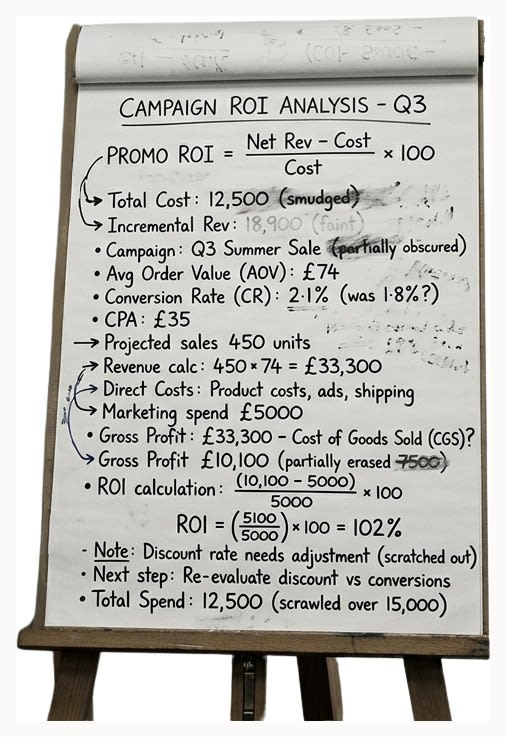
The turning point is the ROI calculation on three promo mechanics, run on the team's own numbers, where people discover that some of what they ran last quarter did not pay back.
A promo recalculated live on the flip chart. Note the crossed-out numbers: the first pass is almost never the one that survives. Net ROI of 102% here is the same call as our gross target of 2.0, and the arithmetic just has to happen before the launch, not after.
Promo ROI, the rule
The target promo ROI is 2: put in 20, get back 40. After this block the team calculates before launching rather than justifying after the fact. That habit, the arithmetic happening in advance, is the thing an online course structurally cannot deliver. A course has nothing of yours to calculate on.
Try it: the same check the team runs
The contract module runs the same logic down to the last fee. The team splits a marketplace price into layers and watches the number shrink:
What a listed price actually leaves you
Then the practical question, which is where it stops being a lesson: how many units a month you need for the target profit, and whether that volume is achievable in your category. Some teams find out it isn't. That is a useful day.
Where we stand
Our experience points at one pattern, and I'll state it as ours: training disconnected from a team's own data rarely moves the numbers. The teams whose figures improve are the ones that spent the day on their own spreadsheets and left with finished decisions.
Feedback scores collected in the room tell you almost nothing about what happens in the quarter. I am not going to pretend I can separate that cleanly from trainer charisma in every case. Plenty of good sessions score well and work. But when I have both the score and the follow-up numbers, the correlation is weak enough that I stopped using scores as a signal.
The format also does not fit everyone. A team of three probably needs one day, not the full cycle; several modules would be dead weight for them. And two days do not fix structural problems. If your analytics aren't in place, the session will diagnose that clearly and then hand the problem back to you. We can build the analytics, but that is a separate engagement, not this.
In our projects, SKU strategy paired with content work has delivered up to 2× growth in marketplace sales, and promo planning plus contract negotiation lifted campaign ROI. The multiple depends on your base and your category, so treat that number as a ceiling someone reached, not a promise.
What changes in 30 days, and in a quarter
Horizon by horizon
The uncomfortable part
The honest test of any training is boring and easy to run. Thirty days later, ask what changed in the numbers. If the team can't point at a card, a calendar, or a killed promo, the money went into a good day rather than a better quarter.
We built ours so that question has an answer. Whether it holds for a year is your job, not ours, and that is the part nobody puts in a proposal.
FAQ
How do you determine what to teach the team?
We collect the company's context first (sites, channels, a team survey, playbooks, strategies, reports), then audit the shopper path, socials, marketplaces and analytics. In the session the trainer opens each block by asking what the room already knows, then closes the gaps on your data.
How is this different from an online eCommerce course?
A course runs on generic examples the team has nothing to connect to. Here the team spends the day on its own brand's data and leaves with finished decisions: a quarterly promo calendar, published review responses, a commercial proposal.
If this works, why don't the big global training providers do it?
Economics, mostly. A program sold to hundreds of companies has to run on examples that belong to none of them, and a pre-session audit of one client's cards, contracts and analytics doesn't scale to that model. It isn't a competence gap. It's what happens when the product is the curriculum rather than the client.
Why is knowledge from ordinary training forgotten so quickly?
Memory keeps what attaches to a real task. Information with no application washes out within a couple of weeks, so every block is tied to work the team already owns.
What sales growth should we expect?
In our projects SKU strategy plus content has delivered up to 2× on marketplaces. It depends on your category, your starting base and whether anyone maintains the practice afterwards. A single multiplier promised to everyone would be a sales number, not a forecast.
Who is this for first?
Australian brands running their own D2C alongside a marketplace presence, where the marketing and brand team owns sales rather than only the creative.
Work with us
If your team went through a training and the numbers didn't move, write to us. We'll review your shopper path and your data, and show you which gaps to close first.




Comments
No comments yet. Be the first.