My name is Michael, and I'm a Head of Digital sharing a bit of marketing magic, plenty of knowledge, and a lot of dedication.
Setting out to buy a Dyson the way any customer would, with a credit card and hours spent to track every intention, thought, move. We purchased it to see the whole picture, including the delivery experience. Somewhere between the search bar and the checkout of this eCommerce customer journey audit, a cheap copy of the product we wanted outranked the real one, the genuine listing went out of stock with no way to be told when it came back, and a cart bug quietly ate our order.
Nope, we didn't give up here, we kept clicking, because this was an audit and not a shopping trip. Most buyers would not. They would hand the money to whoever made it easy, which that afternoon was not the brand that spent a fortune engineering the device.
So here is the opinion we will defend for the next thousand words. The product was never Dyson's problem. The journey was. A premium brand with a broken cart is just an expensive way to send a customer to a copy product.
The Short Version
— A world-class product does not rescue a second-rate buying experience. Customers judge the journey, not the R&D budget.
— On the biggest marketplace, copies and grey-market listings outranked the genuine brand for its own name. That is a search and trust problem, not a factory problem.
— The money leaks at four ordinary places: search, stock, the cart, and a maze of duplicate websites.
— Every leak has a named, unglamorous fix. None of them require a rebrand.
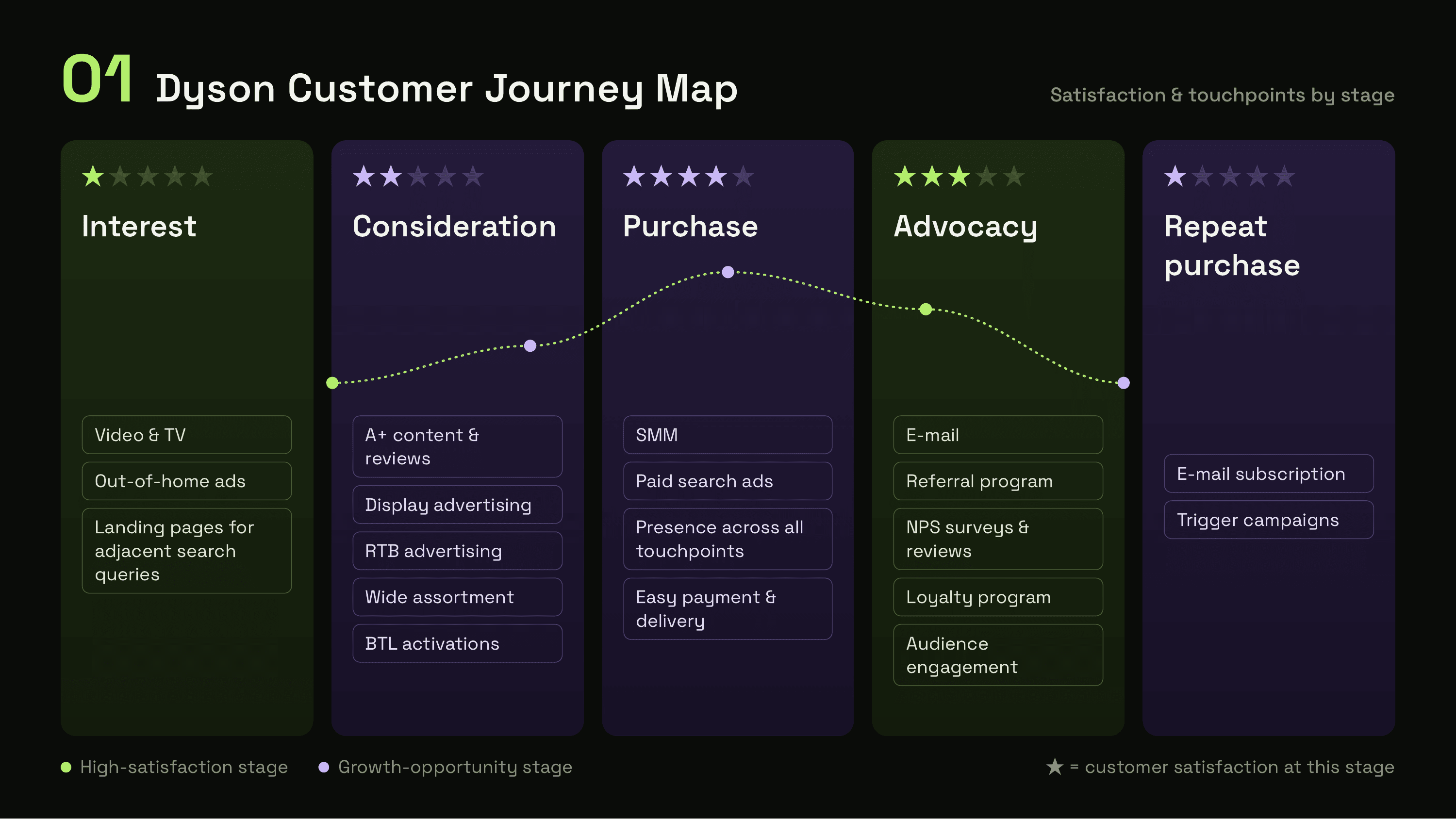
Slide 1 — Dyson Customer Journey Map. Satisfaction climbs toward Purchase, then the experience undoes it.
Why a Great Product Does Not Save a Bad Journey
A customer decides whether you are easy to buy from in the first few screens, long before the product arrives. That is the whole premise of a customer journey map audit: you follow a real buyer step by step and mark exactly where they would give up.
The friction is not rare. Baymard Institute puts the average documented online cart-abandonment rate at roughly 70 percent, and finds that about one in five shoppers walks away from a checkout that is too long or too complicated. None of that is about how good the vacuum is.
Copies make it worse. The OECD has estimated global trade in fake goods at around 460 billion US dollars a year, and marketplaces are where that trade meets your customer. When a shopper searches your brand and a lookalike answers first, the copy is not stealing a sale from a weak product. It is stealing it from a strong one that showed up second.
The copy was not beating a weak product. It was beating a strong product that showed up second.
The Fake Outranks the Real One
On the largest marketplace, a search for the brand returned copies and grey-market resellers above the official listing. The genuine product had a low share of voice on its own name. A buyer who trusts the platform more than the brand, which is most buyers, clicks the first result and never learns it was not the real thing.
Blockercopies and unauthorised sellers own the first screen of results, so the brand competes with fakes of itself and loses the click before price is even a factor.
Unlockregister the brand with the marketplace, publish short authenticity content on every product card, and report or block the grey-market listings on a schedule rather than once. Then earn the first screen with proper listing SEO instead of renting it. The goal is simple, own the first result for your own name.
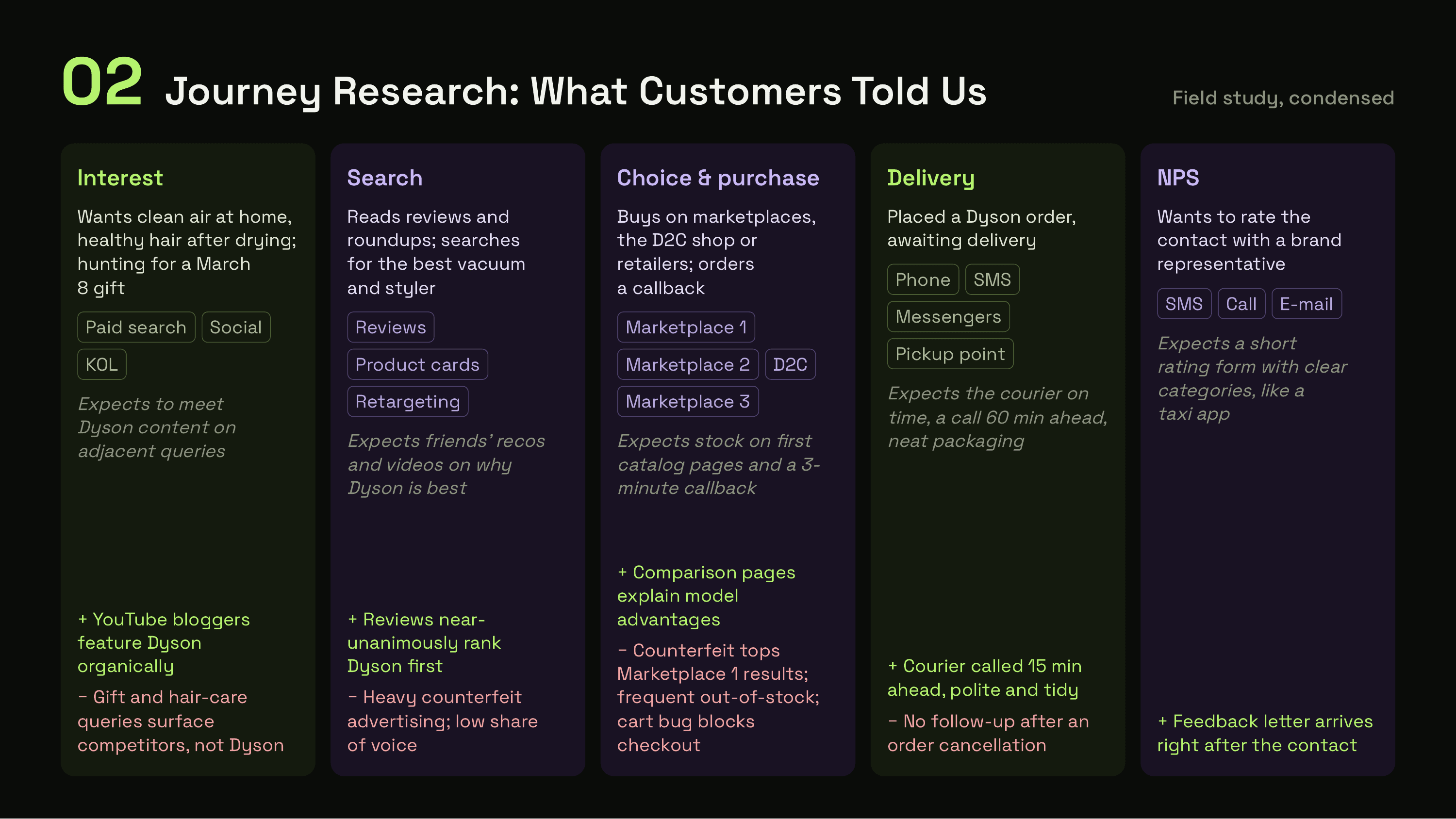
Slide 2 — Journey Research: what customers told us. Green is what worked, the red lines are where the journey lost them.
Out of Stock, With No Way Back
The genuine product was missing from the first catalogue pages, and when it was out of stock there was no way to ask the site to tell us when it returned. A ready-to-buy customer, the most valuable kind, hit a dead end and had nowhere to leave their intent.
Blockerthe buyer arrives holding a credit card and meets an out-of-stock page with no notify option, so the demand evaporates instead of being captured.
Unlockadd a back-in-stock estimate time and alert by SMS or email on every product page, and feed real demand signals into stock planning so the popular models are actually there. A captured email on a sold-out page is worth more than a discount on one that is not.
The Cart That Ate the Order
We filled the cart, went to check out, and a platform bug stopped the order from completing. On the direct site, two overlapping models of the same product sat on the page at once, which is exactly the moment a shopper starts to doubt they are in the right place. The feedback form asked for one field too many.
Blockerthe single most expensive screen in the whole journey, the checkout, was broken by a bug nobody was testing for.
Unlockwrite automated tests for the handful of steps that actually move money, the add-to-cart, the checkout, the payment callback, and run them on every release. Cut the feedback and callback forms to the fields you truly need. If you fix one thing this quarter, fix the step where the money changes hands.
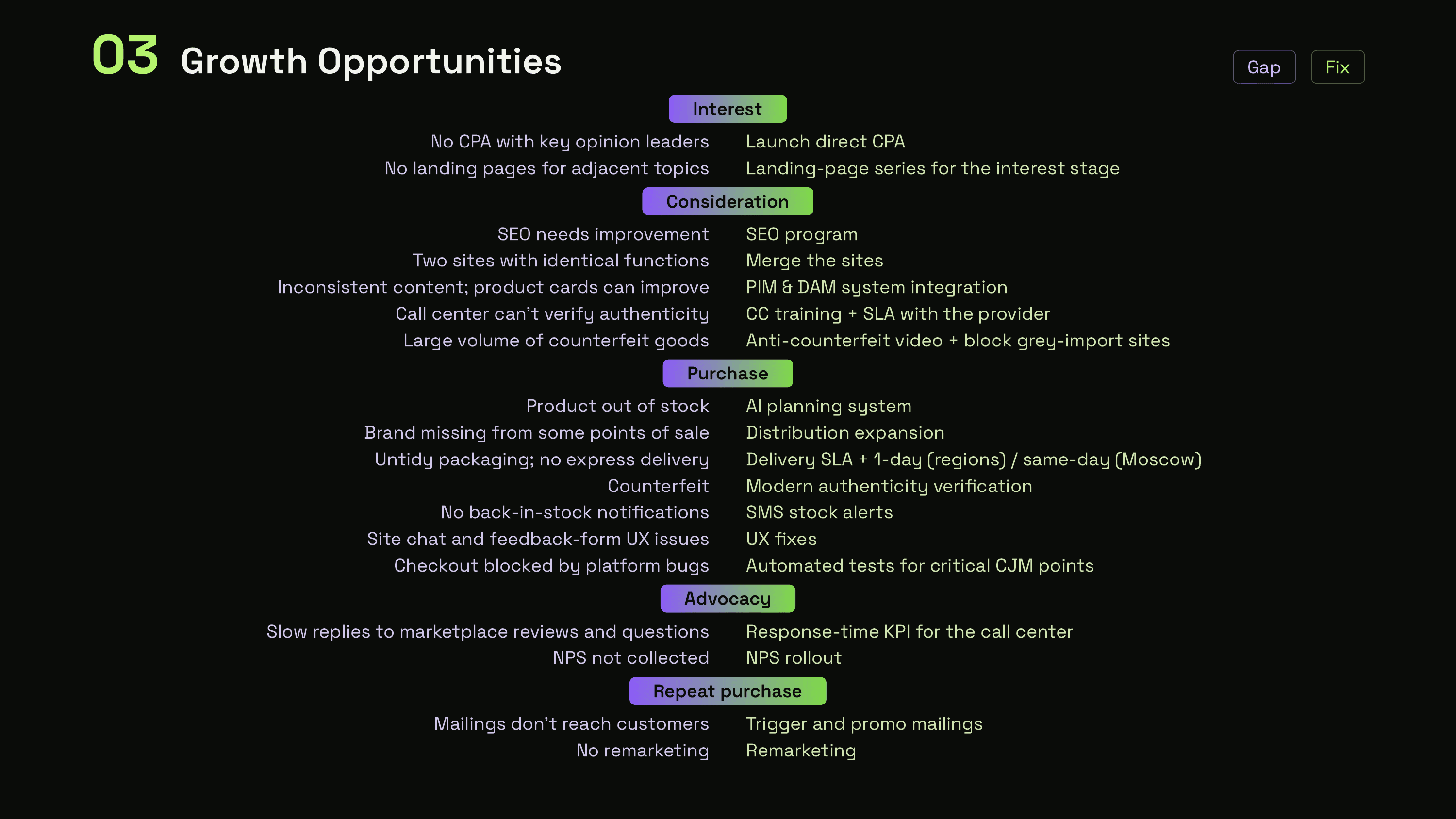
Slide 3 — Every gap we found, paired with its fix. The point of an audit is the second column.
Three Doors, One Shop
The brand ran the customer across three near-identical websites doing one job. Every duplicate splits your search authority and gives the buyer another chance to feel lost. Merging them into one authoritative site is not a nice-to-have, it is how you stop competing with yourself for your own name.
This is also where the paid-search bill hides. When organic rankings are weak because the domain is fragmented, you rent the traffic you should own, and the acquisition cost climbs every quarter. Fixing the foundation is cheaper than paying rent on it forever.
What the Fixes Are Worth
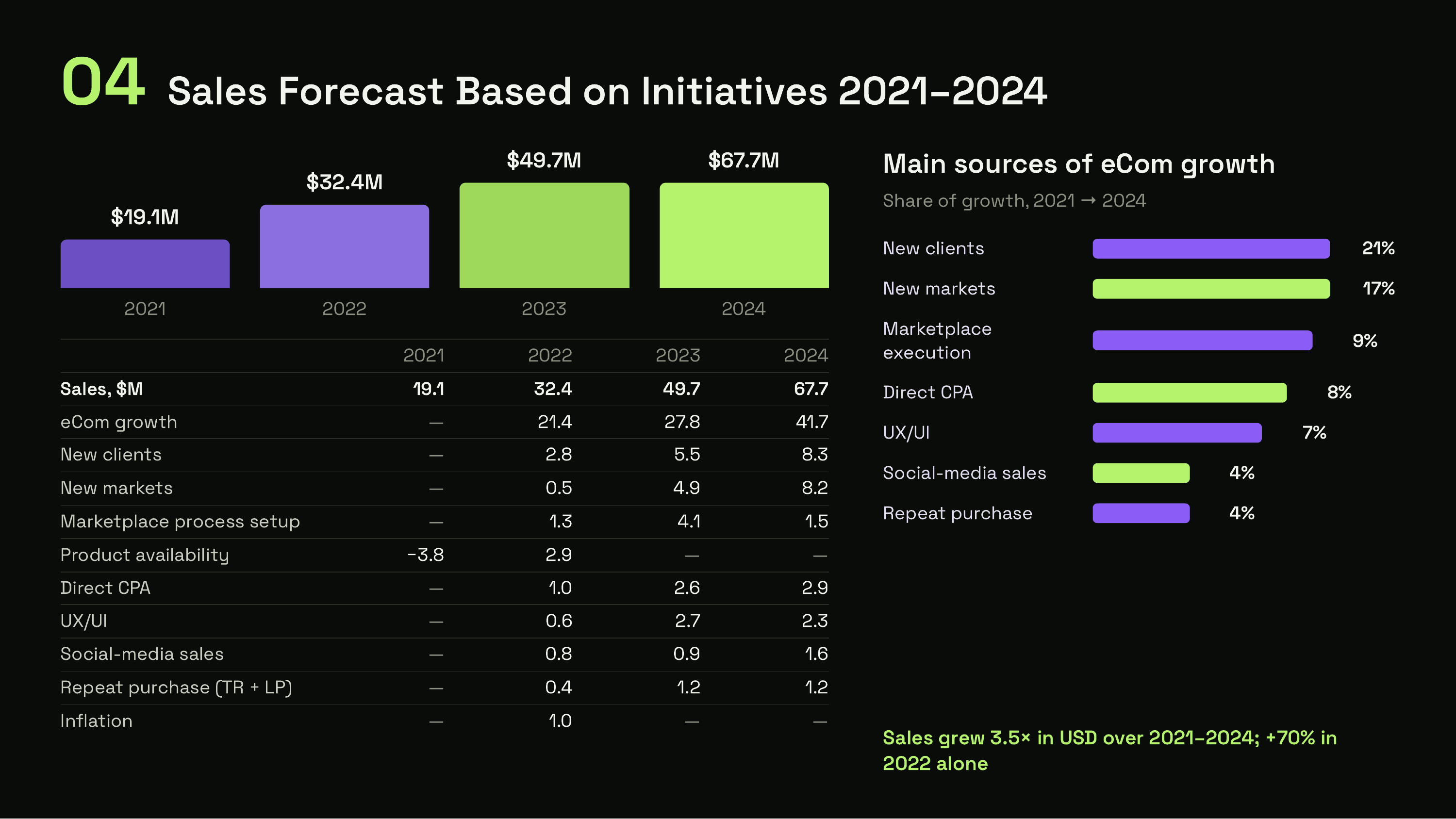
The strategy behind this audit modelled the payoff of closing these gaps. We are marking every figure as projected, because that is what it is: a plan's targets, not a banked result. The honest version is that the direction is defensible and the exact numbers are a forecast.
Projected effect of closing each gap. Read as targets, not banked results.
Slide 4 — The sales projection the plan was built on. Sales grew 3.5x in the model. Read these as targets, not trophies.
Who Actually Has to Do the Work
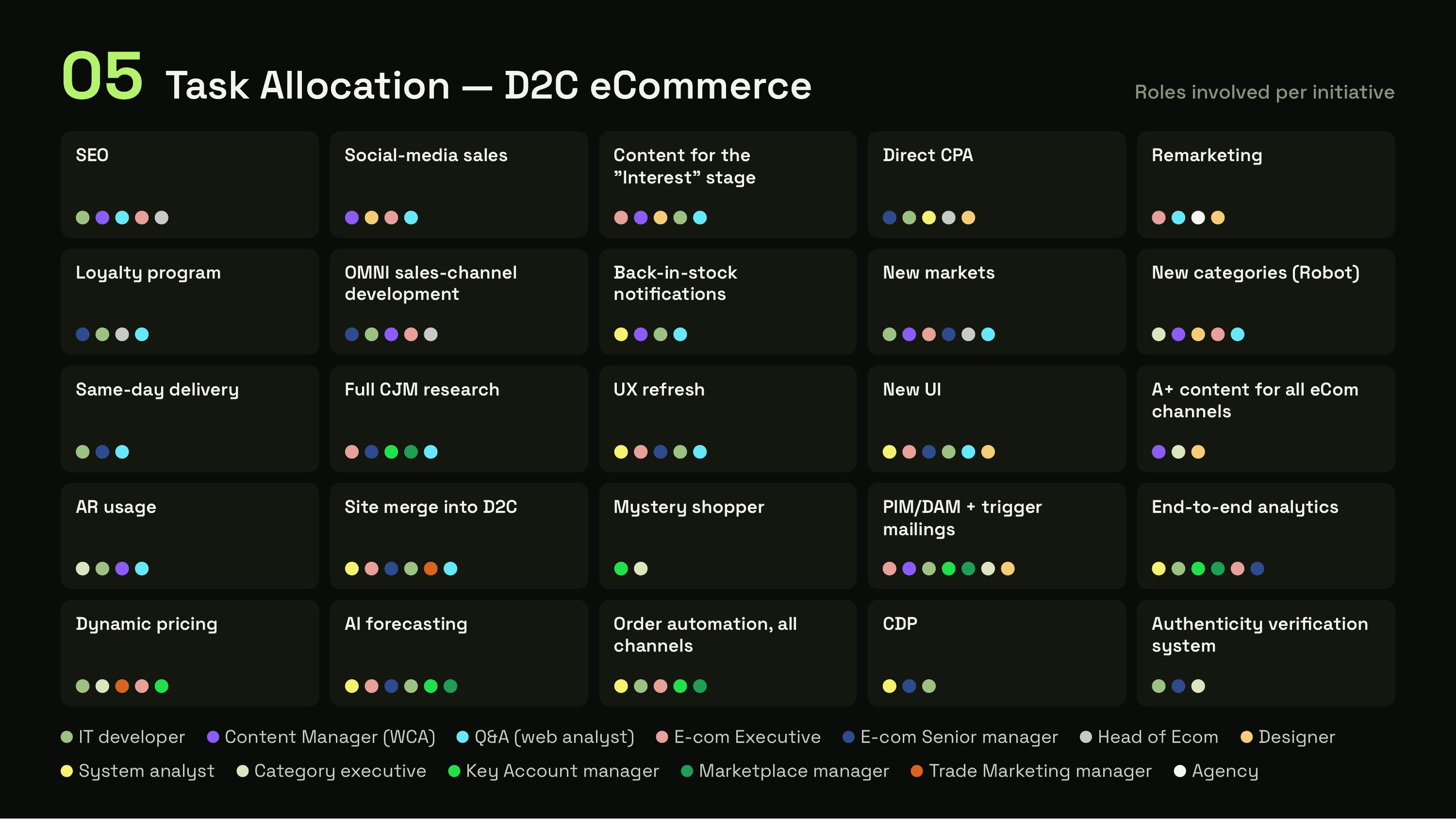
None of this is a single heroic project. It is a stack of ordinary jobs owned by named people, from the SEO lead to the analyst who writes the checkout tests. The reason audits die in a drawer is that the findings never get an owner. So the last artefact we hand over is not a slide of problems, it is a grid of who does what.
Slide 5 — The unglamorous truth of any audit: every fix is somebody's Monday.
What You Should Actually Do First
If this was your brand and you have one quarter, you should not touch the marketing. You should fix the cart, turn on stock alerts, and register the brand on the marketplace where the copies live. Those three are cheap, they are quick, and they stop the bleeding this month. We are 100 percent sure that sequence beats any campaign you could run in the same window.
That is the kind of thing we map for a living at 1door. If your product is better than your funnel, that gap is where your revenue is going. Send us the one step in your own checkout you dread, and we will tell you what it is quietly costing you.
Where 1door Can Help
The fixes in this teardown map straight onto specific 1door services: CX Audit & Customer Journey Mapping, CJM & Conversion Flow Mapping, Customer Experience (CX) Optimization, UX/UI Audit, SEO/AEO/GEO Audit, Marketplace Integration (Amazon & 3rd-party), Website (App) Development, Analytics & BI Stack Build, and QA, Testing. Browse the 1door service shop.
FAQ
What is a customer journey map (CJM) audit?
It is a step-by-step walk through your real buying experience, from first search to post-purchase, marking every point where a customer would hesitate or leave. The output is not a list of complaints, it is a ranked set of fixes with owners and expected impact.
Why do copies outrank the real brand on marketplaces?
Because marketplace ranking rewards listing optimisation, price, and reviews, not who is genuine. If the official store has weak listings and no brand registration, lookalikes and grey-market sellers can sit above it for the brand's own name.
How much does cart friction really cost?
A lot. Baymard Institute measures average cart abandonment at about 70 percent, with roughly one in five buyers leaving a checkout that is too long or complicated. On a premium product, each abandoned cart is a large order lost at the final step.
Is this only a marketplace problem?
No. The same audit found duplicate websites, a checkout bug, and no back-in-stock alerts on the brand's own store. Marketplaces expose the gaps fastest, but the leaks live across the whole journey.
The Machine Was Never the Hard Part
Anyone can admire a good product. Dyson has spent decades making sure of that. The hard part, the part almost no premium brand budgets for with the same seriousness, is being easy to buy from at the exact second someone decides to.
We never did buy that Dyson. The copy was easier, and easy is what gets paid. Fix the journey and the product finally gets to sell itself, which, after all that engineering, is the least it deserves.


Comments
No comments yet. Be the first.